Showing posts with label Fiction. Show all posts

Monday, 4 July 2022

Lindsay Littleson - Author Interview (Q&A) - The Rewilders - Mr Ripley's Enchanted Books #29


Today it's a pleasure to welcome Scottish author Lindsay Littleson to Mr Ripley's Enchanted Books. This interview is very much overdue so it's time to catch up with the author's recent book THE REWILDERS; a thrilling adventure story. The book was a finalist in our recent book cover wars which was very exciting. We hope you enjoy our interview by finding out more about Lindsay's books and her writing career. You can support the author by reading one of her fantastic fantasy adventures. You can buy HERE. 

  1. The Rewilders is your latest book to be published by Cranachan Books (March 2022). How would you summarise the story in a new synopsis to grab the readers' attention? 

The Rewilders takes readers on an exciting adventure to the stunning Highlands. Esme and Callum are on a quest to rewild a young lynx, but their journey is fraught with danger; including a raging river, angry farmers and a pack of menacing wolves. 


  1. Esme is one of the main characters in the book, how do you make your characters believable and stand out from the plot?


For me, creating believable characters is the most important part of writing a novel, because even if the plot’s adventure-packed, if readers don’t care what happens to the characters it’s impossible to create suspense and tension. Readers need to know what makes a character tick, and why they behave as they do, but that understanding should develop and deepen as the story progresses and we find out more about them. 


From bad-tempered Mary Lennox in The Secret Garden to bossy, dramatic Bertha in The Titanic Detective Agency, flawed characters are always more interesting. Lewis in Guardians of the Wild Unicorns can be grumpy and intolerant, but he is courageous, and he is a loyal friend.  Perfection’s dull, and isn’t remotely believable!


Although Esme in The Rewilders might not be immediately likeable, there are reasons behind her behaviour, and hopefully readers will understand, or even relate to, different aspects: her feelings of anxiety when her mother leaves, her fear of stepping out of her comfort zone, perhaps even the fact that she is best friends with a bully because she’s afraid of the consequences of stepping away from the friendship. 


At school, Esme has been siding with her friend Isobel, even when she knows very well that Isobel’s behaviour is frequently unkind. During the journey across the moors to rewild the lynx,  Esme has the time and space to consider the effect bullying has on others and she realises she has to make changes and find the courage to become the person she wants to be. 

  1. Did the Highland landscape inspire any part of the story? 

The Highland moors and Scotland’s ancient temperate rainforests are both the setting of and the inspiration behind The Rewilders. The Highlands are glorious, but the terrible truth is that over the years, the landscape has been damaged and degraded and is now in desperate need of repair and regeneration. The message in the Rewilders is primarily about the urgent need to protect and repair our precious wild environments, as much for our own sake as nature’s. 

Only fragments of internationally important Scotland’s temperate rainforests remain, and discovering about them inspired this description in The Rewilders

With its craggy rocks and gushing waterfalls, this place felt other-worldly—like a fantasy film set—a magical forest of wood elves and unicorns. But it wasn’t magical, it was real; a living reminder of Scotland’s past. Weak autumn sunlight slanted through the mainly deciduous trees, a mixture of birch, ash, hazel and a few ancient, gnarled oaks. Their bark was crusted with rust-orange lichen, their leaves turning scarlet and gold. Spongy moss carpeted the soggy ground and furred the tree branches. 


  1. Do you think being a Scottish author that local heritage is important to portray in children's stories? 

Obviously, Scottish authors should feel free to write the stories they are passionate about, and I don’t feel restricted to writing stories set in Scotland, as The Titanic Detective Agency proves! But I do believe it’s important that children are aware of their local history. I spent many years as a teacher in the Paisley area, and the main reason for writing my Victorian novel, A Pattern of Secrets was to give local children information about their town’s incredible textile heritage, within an adventure story about 12-year-old Jim who escapes from the Abbey Poorhouse and has to attempt to save his little brother from the same fate, by retrieving a lost family heirloom.

While The Rewilders is set in Scotland and focuses on the topical issue of rewilding large predators, such as lynx and wolves, to the Highlands,  the novel’s main message is a global one. It’s vital that we all do our part in protecting and restoring our planet’s natural environments and in caring for our precious, vulnerable wildlife. 

  1. What kind of books did you enjoy reading as a child? 

The Borrowers series was a revelation. The novels have a gloomy, melancholy air, very different from the upbeat adventure stories of Enid Blyton, all of which I’d already devoured, and I loved Arrietty’s courage and desire for adventure. The Hobbit, Mrs Frisby and the Rats of NIMH and the Narnia books were all fantasy favourites too. But I also enjoyed character-driven stories about children to whom I could relate in some way, like Kate Ruggles in The Family From One End Street, surrounded by siblings and desperate for a place to read in peace. 

  1. You have a number of successful books that have been published, at what point do you decide to commit to writing a story to the very end or choose to abandon it?

When I first began writing I produced quite a few stories that should have been abandoned at an earlier stage and which eventually ended up in a drawer. Gradually, I realised the way I worked needed to change. More planning at the initial stages was essential, to try and reduce wasted time. So now, when an idea first emerges, I doodle my characters and annotate the drawings; describing each character’s physical appearance and personality traits, both negative and positive. Then I might draw a map of the setting or create a family tree. If I’m feeling really keen to tell this story and in love with my characters, then I’ll begin writing rough chapter outlines and hopefully from those, I’ll be able to produce a workable first draft. But obviously there are no guarantees!

  1. What feelings do you have when you walk into a place filled with books? 

Libraries always make me feel nostalgic. I remember so clearly visiting our local library with my mum every week. She would have a little wheeled trolley with her, because she’d borrow so many heavy hardbacks, one from each section of the library, that we couldn’t carry them home. I’d skip into the children’s section, fingers crossed that there would be something new, something I hadn’t yet read. 

When I enter a second-hand bookshop, I breathe in the slightly musty smell, and feel a thrill of anticipation and a buzz of excitement, because I’m on a treasure hunt. My latest treasure is a battered copy of Selfridge’s Household Encyclopaedia from 1929, which earnestly explains that appendicitis is caused by swallowing fruit pips or toothbrush bristles and has some excellent advice on the etiquette around visiting cards.

  1. What question would you have loved for me to have asked you and why? 

I would have loved you to ask me what I am working on at the moment, because my brain is currently buzzing with ideas for A Spy’s Guide to Europe, the teaching resource I’m creating to accompany my new MS, Euro Spies. The novel is about three school children on a whirlwind trip around Europe, who are catapulted into a world of art, espionage and terrible danger. Euro Spies features fiendish clues, all hidden on famous European landmarks, and lots of hard-to-crack codes. The novel was an absolute joy to write and it’s coming out in April 2023. 


Website:http://www.lindsaylittleson.co.uk/books/

Twitter:https://twitter.com/ljlittleson


Monday, 9 July 2018

Tania Unsworth (Author), Helen Crawford-White (Illustrator) - The Girl Who Thought Her Mother Was a Mermaid - Book Review


Even though she's terrified of the sea, a girl who believes her mum might have been a mermaid runs away to the ocean to solve the mystery of who she really is. Stella is the odd one out. She sleepwalks, is terrified of water, yet obsessed by the ocean. Her mum who died when Stella was eight remains the biggest mystery of all. Who was she and why did she give Stella a necklace called 'the word of the sea' before she died? Nobody can give her any answers. Her father is consumed by grief and her grandmother's memories are fading with dementia. 
When Stella's only friend in the world, Cam, moves house, Stella runs away. She's determined to find out who her mum was and who she is too. She ends up in the Crystal Cove, a run-down aquarium with a mermaid show. There she meets Pearl who reveals disturbing secrets. It's only by facing her fear of the ocean that Stella will truly uncover the truth.
Summer is here with a loud bang. Wimbledon and strawberries, blue sky and sun, sandy beaches and ice cream, as well as loads of great books to read. With so many books wanting and waiting to grab your attention, July is all about books that inspire the readers to escape and to enjoy the great outdoors. The first book for review is Tania Unsworth, The Girl Who Thought Her Mother Was a Mermaid, published by Zephyr on the 12th July 2018. 

The book cover artwork by Helen Crawford-White is absolutely brilliant and instantly makes you want to explore the story inside. All you have to do is turn the pages and dive straight into the crisp cool waters of the narrative. Once the pages are turned, you are introduced to the main character, Stella. Unfortunately, at eight years old she unexpectedly loses her mother to illness. The narrative is filled with sadness and loneliness exploring the character's grief. However, things begin to look brighter when a new neighbour, Cam, moves in next door. The story takes you on an uplifting adventure of self-discovery and friendship which washes over the reader like gigantic waves crashing against the shore. It's a story of self-discovery that will shine brighter than the sun regardless of age or gender.

This is a brilliant story in which to escape to. As you dive below the sea, it gives you a whole new perspective on the world. It's a book full of wonder and mystery that leads the reader down a path full of dark magic and a heartfelt story. I loved the simplicity of the plot, which is delivered with great imagination, whilst the storyline challenges the beliefs of the reader and the characters of the book in so many ways.

I loved the conversations between Stella and her grandmother. With her loss of memory, it was very well written and incredibly endearing. It really enhanced the storyline of the plot through the poignancy and compassion shown whilst still managing to explore the reality both characters face within the story. I also loved the balance between fantasy, reality, dialogue and action. It really makes this story an amazing lazy summer afternoon read. 

This is a great recommended read that whets the appetite. It's about facing your fears and looking for the truth. 
SaveSaveSaveSaveSaveSaveSaveSaveSaveSaveSaveSave

Thursday, 2 March 2017

Christopher Edge: Guest Post - Top 3 Inspirations Behind The Jamie Drake Equation - #WorldBookDay Post

Happy World Book Day everybody. Today will also see the publication of Christopher Edge's latest novel The Jamie Drake Equation. It will spread its wings and fly off, courtesy of Nosy Crow, and can be found in all good book shops today. I recently read and reviewed this book and really loved it, so see what I had to say about this book in my review HERE. Anyway, I would like to welcome Christopher to Mr. Ripley's Enchanted Books blog to talk about the inspiration behind his book. 

No book tumbles from the mind of its author without a spark of inspiration to send it on its way. Here are the top 3 inspirations behind my new book, The Jamie Drake Equation. 


E.T. 

The Jamie Drake Equation is about a ten-year-old boy called Jamie whose dad is an astronaut on the International Space Station getting ready to launch humanity’s first interstellar mission in search of alien life. Perhaps the most-famous fictional alien ever created is Steven Spielberg’s E.T. I remember my older brother taking me to watch this movie at our local cinema and craning my neck from our front-row seats as this spellbinding film of first contact unfolded on the screen. But more than being just a film about aliens, E.T. is a story about friendship, family and the impact of his parents’ divorce on Elliot. And in The Jamie Drake Equation, Jamie’s encounter with a strange message from the stars is the start of his realisation that his family life isn’t as perfect as he thought.

Astronauts 

Last year I had the honour of hearing the Canadian astronaut, Commander Chris Hadfield, speak at the Emirates Festival of Literature in Dubai. He spoke about his childhood dreams, of humanity’s greatest achievements, the wonders of the universe and the power of inspiration. “It begins with the spark of an idea,” he said, “It begins with literature.” Powerful words for any author to hear!

I saw for myself the inspiration that space exploration can spark when my son and daughter both rushed home from primary school, buzzing with excitement after taking part in the Cosmic Classroom live link with Commander Tim Peake onboard the International Space Station. And as we sat together to watch the ISS soar through the night sky, the story of The Jamie Drake Equation started to take shape in my mind. 


David Bowie 

I first heard David Bowie’s music on a mixtape that a friend made for me when I was seventeen, ‘Life on Mars’ nestling between Syd Barrett and the Smiths. And from the moment the piano intro played and Bowie started singing of the girl with the mousy hair, I was entranced. Working as a Saturday boy in Our Price Music, I quickly schooled myself in David Bowie’s back catalogue: Hunky Dory, The Rise and Fall of Ziggy Stardust and the Spiders from Mars, Diamond Dogs, Young Americans, Low, Let’s Dance... until the record-buying public of Bolton rose up in protest and demanded I started playing Right Said Fred instead. 

From Space Oddity to Blackstar, David Bowie’s music has always been written in the stars, his lyrics slipping free from Earth’s gravity to explore science fiction themes, loving the alien and giving a voice to the alienated. David Bowie died while I was writing The Jamie Drake Equation, but in my mind his music was the soundtrack for key scenes in the story. I talked about the book soundtrack I created for The Jamie Drake Equation with Chris Hawkins on BBC 6 Music and you can listen to the interview Here. And if you’d like to see which scenes Bowie’s songs soundtracked, you can listen to the chapter-by-chapter soundtrack Here. 


So these are a few of the inspirations behind The Jamie Drake Equation: aliens, astronauts and a singer made of stardust.


Synopsis: How amazing would it be to have a dad who's an astronaut? Rocket launches, zero gravity, and flying through space like a superhero! Jamie Drake's dad is orbiting the Earth in the International Space Station and Jamie ought to think it's cool but he just really misses him...Hanging out at his local observatory, Jamie picks up a strange signal on his phone. It looks like alien life is getting closer to home. But space is a dangerous place and when his dad's mission goes wrong, can Jamie prove that he's a hero too? A cosmic adventure for anyone who's ever looked at the stars, from the author of The Many Worlds of Albie Bright. Cover illustration by Matt Saunders.


Website:www.christopheredge.co.uk

Monday, 31 October 2016

Guest Post: Andy Seed - Prankenstein On Tour - Total Write-Off: Fiction vs Non-Fiction (Halloween Day)


Welcome, Andy Seed, to Mr Ripley's Enchanted Books to celebrate the publication of the third book in the Prankensteinseries which was published on October 6th by Fat Fox Books. The story sees our hero, Soapy Thompson, having a fun time on a world cruise along with his friends from Estonia, Arvo and Loogi (the 'twince'). All is going well until some modern-day pirates board the ship and kidnap Soapy's mum. 

This is a brilliantly illustrated (Richard Morgan) silly adventure full of fun and trouble aimed at readers 7 years and upwards. Here is Andy's Post Total Write-Off: Fiction vs Non-Fiction.


Most children’s authors write made up stuff and some write true stuff. The made up stuff (i.e. stories) comes under the boring label ‘fiction’ and the true stuff (i.e. fact) has the completely useless title of ‘non-fiction’. If ever there was a phrase to send children to sleep, someone has found it and attached it to a whole sphere of publishing. To make matters worse the label is absurd: how can you define something by what it’s not? ‘Coffee or non-coffee, madam?’ 


I’m one of the few authors who writes both novels and factual books for kids and because they are so perceived to be so different you might think it’s almost like having a split writing personality. With fiction there’s a blank page and the author is the creator of people, places, events – the controller of time, space and, well, everything. With non-fiction there’s a known world out there: a box of information into which you dip and select and then weave into some kind of paper presentation, probably with pictures and diagrams and facts and figures. 


Except that it’s not that simple. Most of the time fiction writers work within the real world and need to do lots of research to ensure that their tale has plausibility and a convincing setting. My most recent novel Prankenstein on Tour may be a funny romp about a prank-playing monster who sends a world cruise into meltdown but it still needed to be set on a ship which reads like a real ocean liner and the characters needed to visit real places with buildings and details described as they really are. 


So, fiction writers must check their facts too, a lot of the time, and therefore blend imagination with reality. Of course if you’re setting a story on Planet Mooku in the year 3028 then it’s a different game although your spacecraft will still have to obey the laws of physics and the galaxy you’re in must make sense to the reader. 

In the case of Prankenstein on Tour, it’s the third book in a series and I really enjoyed the fact that I could re-visit previously created settings and work with established characters, injecting humour and fun into the story. In the book, the central character Soapy Thompson, aged 12, is overjoyed when his dad wins a world cruise for five and even more excited when his best friends, the detective-like Estonian twins Arvo and Loogi can come along too. The problem is cheese. If Soapy eats any he turns into an uncontrollable prank-crazed beast. Normally there’s no cheese at his house but here on a giant cruise ship… 


So, what about writing non-fiction? Well, for a start it doesn’t just cover facts. My own non-fic children’s titles, such as The Silly Book of Side-Splitting Stuff which won the 2015 Blue Peter Best Book with Facts Award is mainly factual but contains jokes, riddles, silly names, poems and lots of other content that was created rather than researched. 


Children sometimes ask me if it’s harder to write fiction and usually I say it is because you have to create a whole world and then make the characters in it take us on a journey which will draw us in powerfully. Yet there’s a huge imaginative process in the writing of factual content too. There are a million ways to do it and more. Take the fact that the tiger is the largest of all cats. How can that be presented? Written in a dull sentence, yes, but a picture would help. A photo? What about a comparison with another animal or a human? A diagram? Some kind of snappy graphic? Instead of telling its weight in kg, how many 5 year-olds might it weigh the same as? (18 using averages) and so on. There’s a different kind of process but it’s still highly creative. 


There are places where the two worlds collide too, of course: biographies and true stories for a start. So maybe fiction and non-fiction aren’t so different. But pleeeeease, let’s have a new label for the latter.

Monday, 23 November 2015

Guest Post: Superman, Batman and er.. Nick O’Teen by Tim Collins (Author of Adventures of a Wimpy Superhero).


My new book Adventures of a Wimpy Superhero is about a boy who loves comics so much he decides to become a masked crime-fighter himself. But he discovers that making the world a better place while wearing tight-fitting Lycra is harder than it looks. 


Comics played a huge part in turning me into a reader, as they did for so many others of my generation. While I associated books with the classroom and learning, comics were part of the colourful world of play. 


My first encounter with superhero comics was very odd. In the early eighties Saatchi and Saatchi produced an anti-smoking campaign featuring Superman and a villain called Nick O’Teen, who gave cigarettes to kids. After viewing a TV ad, I sent away for a free comic in which superman pretty much murdered him for his crime. As far as I was aware, Nick O’Teen could have been the most important baddie of the DC Universe, outranking Lex Luthor and The Joker in the underworld hierarchy. 


Harsh as Superman’s treatment of Nick O’Teen may have been, it did the job. I never took up smoking, though I did get addicted to comics. I’m down to just a couple a day now. 


Batman was the best, of course (Yes, I know Superman could beat him in a fight, but that’s not the point). Away from the giddy camp of the sixties show, still repeating on Saturday morning ITV, the Caped Crusader was becoming the Dark Knight. It helped that my school was very near to Manchester’s best comic shop Odyssey 7. We were reading Frank Miller and Alan Moore while others had to make do with Action Force. 


Batman was no longer cast as the world’s greatest detective, which was just as well, as his detective skills mainly involved dangling henchmen off high buildings until they gave up the whereabouts of a supervillain. Instead he was a brooding, tortured anti-hero. Some of his adventures were even recommended for mature readers, though the middle-aged men who collected them didn’t look very mature to me. 


My love for superhero comics was sealed in 1986 with the launch of Watchmen. At the time, I could hardly have known that the comic I was sneaking out to buy was more complex and challenging than the stuff they wanted me to read in school. 


Though much of it swooshed over my head, Watchmen raises some very disturbing questions about the very idea of superheroes. Why would someone want to take the law into their own hands? What kind of a right-wing psycho would distrust society so much they took to dispensing instant vigilante justice? 


Though my book is light-hearted, I’ve tried to include some of this debunking spirit. At one point the hero Josh wonders if it would be better to let a bank robbery take place than to foil it. There would be a lot less damage to property and risk to civilians if they just let the robbery go ahead and left it to the big insurance companies to pay out. And is it really worth putting on your mask and tights to protect a bank? It’s not as if those institutions have ever done much for us. 


In real life, it can be very difficult to work out who the actual supervillains are.


Tim Collins is originally from Manchester, but now lives near London. At first he wrote non-fiction books for adults, but five years ago he began to publish children's fiction. He has now published over fifty books that have been translated into over forty languages. These include series fiction like Wimpy Vampire, Cosmic Colin, Dorkius Maximus and Monstrous Maud. All his books are very funny; they are exactly what children want. Check out this article What Kids Want in Books.

Tim has also written many stories for reluctant readers such as Troll, Joke Shop, The Locals, Mr Perfect and Dawn of the Daves. He has also won several awards such as Manchester Fiction City, The Lincolnshire Young People's Book Award and The Kalbacher Klapperschlange. 


Author's Website: timcollinsbooks.com

Author's Twitter Page:  

Tuesday, 16 December 2014

Mr Ripley's Enchanted Books: Top Ten Favourite Reads 2014


Mr Ripley's Enchanted Books is coming to the end of yet another reading year. 
I would like to take this opportunity to highlight some of my favourite reads of 2014. 

The below books are in order of the publishing date and not in order of merit as I loved them all for different reasons. 

So here is the list.....

1) Simon Mason - Running Girl - Published by David Fickling - Jan 2014
The solving of the crime takes a fresh and non-stereotypical approach to keep you on your toes.

2) David Gilman - Monkey and Me - Published by Templar Publishing -  Feb 2014
There were times when I laughed out loud and times when I was on the verge of tears in this warm and moving tale. It would be a great read for youngsters however it does work very well on more than one level. 

3) Howard Sargent -  The Forgotten War - Published by Book Guild - Feb 2104 - (Adult Book)
This book is coming together like a cauldron full of magic; it's all binding together like a witches spell..... The ingredients are rapidly coming to boil as we plough further into the story. The action has intensified and a shock death in one of the many plots has slightly shocked me. As I progress further into the story it now feels like a well worn shoe. I love the complex structure of the story, it is very clever and must have taken some time to map out. 

4) Sophia McDougall - Mars Evacuees - Published by Egmont - March 2014
What you will find is a fresh, fast-paced space romp. A group of children fighting to save themselves from themselves in order to rescue the galaxy. This is science fiction where children rule. This book, in my opinion is one of the best reads for me this year and one of the most exciting books that you will find for both boys and girls.

5) Cameron McAllister - The Tin Snail - Published by Corgi Children's -  May 2014
In my opinion, this is a beautifully written story. I loved every minute that I spent reading this book. It is easily set to be a classic hit this summer. A fantastic family read; this is a story with a big heart based on an amazing idea. A poignant tale filled full of warmth, great characters and the coming together for the common good. 

6) Steve Feasey - Mutant City - Published by Bloomsbury Children's - May 2014
This is the best read in the teenage horror genre that I have read for some time. It will make you hair turn green. It has got everything that I look for in a story and more. It's very cool and one that boys will love and girls will come to love. In my humble opinion, this is a really well delivered story set in a fantastically dark and futuristic world with imagination and creativity at the height of the genre. This is amazing stuff; I am really looking forward to the next instalment.

7) Eoin Colfer - W.A.R.P - The Hangman's Revolution - Published by Puffin - June 2014
I warped with full speed into the story; my mental agility soon reached overload. From the very first page, the reader is flung straight into the action following young FBI agent Chevie bags-of-attitude Savano. Trapped in a nightmare future, she needs to return to 19th century London to change the course of history. Can she do it? Well, that you will have to find out.  

8) David Barnett - Gideon Smith and the Brass Dragon - Published by Snowbooks - Sep 2014 - (Adult Book) 
This is a first class piece of literature. It depicts a highly imaginative world where the sense of adventure is written in abundance. The story is filled with adult humour and colourful language.  The characters are full of life and explode of every page. They are cocky, sharp, intense and very witty; a fantastic balance for a story of this nature. 

9) Garth Nix - Clariel - Published by Hot Key Books - October 2014
I have been looking forward to this: the latest of Garth Nix’ Old kingdom novels and I wasn’t disappointed. Five star fantasy entertainment.

10) Danny Weston - The Piper - Published by Andersen - October 2014
Just like the Pied Piper and the town rats, you are soon hypnotically drawn into the mysterious past. It is like an eerie melody that plays repetitively and alluringly until you finally wake up. Be aware though, as you might not be in the same place that you were before you started reading. It is a spooky fantasy that will hit you full in the face the more that you read 

I would like to take this opportunity to thank you all (readers, authors, illustrators and publishers) for your support in 2014. I'd like to wish you all a Merry Christmas and a wonderful start to the New Year.

Tuesday, 10 August 2010

GUEST POST – “The Familiars” by Adam Jay Epstein & Andrew Jacobson

“Adam’s Top 5 Favorite Fantasy Books”
ADAM JAY EPSTEIN spent his childhood in Great Neck, New York, while ANDREW JACOBSON grew up in Milwaukee, Wisconsin, but the two met in a parking garage out in Los Angeles. They have been writing for film and television together ever since. The Familiars  is their first book.
One day, Adam asked Andrew, “Are you familiar with what a familiar is?” And from that simple question, Vastia was born, a fantastical world filled with the authors’ shared love of animals and magic. They wrote every word, sentence, and page together, sitting opposite each other.
Adam Jay Epstein lives in Los Angeles with his wife, Jane, their daughters, Penny and Olive, and a black-and-white alley cat who hangs out in their backyard. Andrew Jacobson lives with his wife, Ashley, and their dog, Elvis, four traffic lights away.

THE FAMILIARS will be produced for film by Sam Raimi and Sony Animation.
Fantasy fiction has created my love of reading from an early age. No other books captured my imagination the way that they did, and often I dreamt of living in those worlds as I sat in bed each night devouring the pages.
5. “Something Wicked this Way Comes” by Ray Bradbury
Not sure you would call this fantasy in the tradition way, but it’s filled with magic and scares and a fantastical world that lies just beyond our eyes in the neighborhood carnival. It scared me silly when I first read it. It was evocative and unique. And although it was tough to choose between this and “The Illustrated Man” as my favorite Bradbury tale, I had to go with this one, seeing as how picking an anthology seemed like cheating.
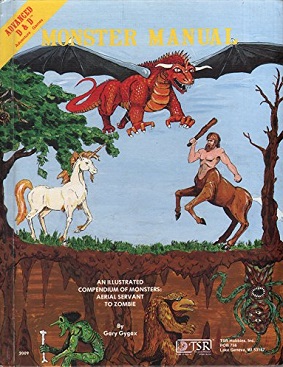
File:MonsterManual-1stEdAD&D-Cover.jpg
4. “The Dungeons and Dragons Monster Manual” by Gary Gygax
Before I ever started reading novels, in third grade this was my introduction to fantasy. A friend’s older brother turned me onto it and after I purchased it and brought it home, I read it cover to cover. There’s no story, just a list of magical monsters in alphabetical order, but each one was like a story to me. And an excellent primer on mythology, both Greek, Norse, and Babylonian.

Early edition cover


3. “Spell for Chameleon” by Piers Anthony
In fifth grade, my dad gave this book to me. Up until that point, I wasn’t really interested in novels at all. I’d rather read my dragon magazines and make up stories of my own. But on his recommendation, I started it, and couldn’t put it down. It was funny and the world of Xanth was like nothing I had ever seen. Plus with surprise twists and turns it got me hooked on the art of storytelling.

Harry Potter and the Prisoner of Azkaban (Book 3) Paperback
2. “Harry Potter and the Prisoner of Azkeban” by JK Rowling
My favorite of the Harry Potter series, although “Deathly Hollows” comes in a close second. The most emotional one for me and the only one that made me cry. Stories of parents and their children always connect in a special way for me. Also the tight, clever storytelling and brilliantly planted plot puzzle pieces come together in such a rewarding way in the end.
The Hobbit
1. “The Hobbit” by J.R.R. Tolkien
The first Tolkien I ever read, and yes, still my favorite even over “The Lord of the Rings.” The classic hero’s journey tale and the book which all other fantasies are indebted, including mine!
“The Familiars” at www.thefamiliars.com.

Featured post

Emma Rea - ENTANGLED - Book Review - Mr Ripley's Enchanted Books

By Emma Rea | Cover artwork by Kade Doszla Published by Firefly Press| 2nd April 2026 | ISBN 9781917718189 A Thrilling Venetian Quest!   Emm...