Showing posts with label Blog Tour. Show all posts

Sunday, 20 May 2018

Victoria Williamson - Where Do Ideas For Stories Come From? (The Fox and the White Gazelle Blog Tour)


It's a pleasure and a delight to be hosting a guest post from Victoria Williamson.  'The Fox and the White Gazelle' was published on the 19th April 2018 by Kelpies of Edinburgh. 

Reema runs to remember the life she left behind in Syria. Caylin runs to find what she's lost. What follows both characters in this book makes for a thought-provoking and moving journey. It takes you through a set of emotions that will stay with the reader. It's a life story that came from a seed of reality and ends in the realm of fantasy. Nature versus nurture with a strong sense of belonging. 


Many thanks to Victoria for sharing this post with us all. I hope you enjoy - thank you for taking the time to read it.  


One of the most frequent questions an author gets asked is ‘Where do you get your ideas from?’ 


That was an easy question to answer when I was six or seven: I stole them. And not even subtly. There was no half-hearted attempt to disguise the plagiarised re-telling of books I’d read, tv shows I’d watched or films I’d seen. My early ‘books’ were made of pieces of paper stapled together and filled with scenes from my favourite cartoons. The first play I wrote and performed with some friends in my P3 class was a rewrite of the plot of The Worst Witch. I retold the stories that excited me, imagined myself going off on the adventures I read about and saw on the screen, and changed a few details here and there to make myself the hero of these tales. 


And soon a funny thing happened. The adventures began to take on a life of their own. I was still writing stories about the Thundercats or dreaming up mysteries for Tintin to solve. But the plots were new, and all of my own making. Later, when I stepped through the magical wardrobe in my imagination, instead of finding Narnia on the other side, it would be a different world, peopled by characters I had invented, with stories all of their own I had never read before.


That’s why as a teacher I get a bit annoyed by the insistence on ‘originality’, particularly for children in the early years. It’s one thing for a twelve-year-old to hand in a half-hearted retelling of a tv show for a creative writing exercise, but surely we should be helping younger children to become enthusiastic writers by letting them tell the tales that truly thrill them? ‘Write about anything you like’ is so vague that adults who’d love to write a children’s book are left scratching their heads wondering where on earth they’re going to find a great idea, so why do we expect small children to be able to do this from a young age? Yes, children have vivid imaginations, but if you listen carefully, most of the stories they’re telling are about tv shows they’ve seen and books that have been read to them, just like mine were. The children who are encouraged to write these down while they’re still excited about them, instead of being told to think up something completely new, are often the ones that, years later, become authors with stories of their own to tell. 


And like many authors, even as an adult I spend a ridiculous amount of time living in my head, in worlds filled with characters I had invented from tv shows, films and books. Some of the best stories I’ve written in my head but never committed to paper are fan-fiction episodes of Game of Thrones, Doctor Who or Supernatural. Writing well requires constant practise, just the same as playing the piano proficiently or playing a great game of tennis. But just like practising the piano or tennis, there’s no need to do something new every time. Writing has its scales and service games to rehearse too, but they needn’t be a chore. 


I often say to writers who are struggling to come up with ideas to go back to writing the way they did when they were very young, before the need to be original became a stifling requirement. Turn writing into a game, and rediscover the excitement of slipping into the role of your favourite character, battling monsters or flying dragons in magical faraway lands that are already 

out there waiting for you. Soon you’ll be meeting unexpected characters and coming up with different plots along the way, and with a bit of luck and a lot of practise, some of those will turn into brand new stories that have never been told before.


Victoria Williamson grew up in Kirkintilloch, north Glasgow, surrounded by hills and books, and started writing adventure stories at an early age, with plots and characters mostly stolen from her favourite novels and TV shows! These days her stories are all her own, featuring the voices of some of the many children she has met over the years on her real-life adventures around the world.

Victoria has been a teacher for many years, working in all sorts of exciting places from Cameroon, Malawi and China to the UK. She has lots of educational resources available to go with her books, and she is very happy to visit schools to talk to students about reading, writing and the issues raised. 

You can find out more about Victoria by following her on Twitter or visit her website.


Wednesday, 11 October 2017

Guest Post - Sarah Baker - Eloise Undercover - UK Blog (5) Tour - MORSE CODE (Catnip)

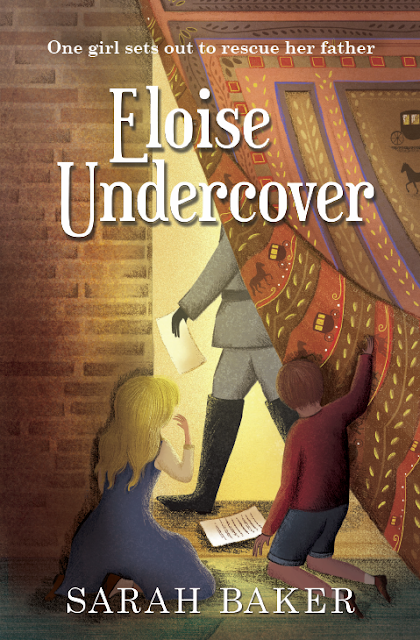
ELOISE UNDERCOVER

France, 1944. 12-year-old Eloise’s father has not come home in over a week, and she is getting worried that something might be badly wrong. When the Germans occupy Eloise’s town, and the Nazi Kommandant moves into Maison de la Noyer, things start falling apart. Through a chance meeting, Eloise volunteers to join the Resistance. Suspense, secrecy and danger follow her as, inspired by her favourite detective fiction books, she tries to find her father. A hidden passage behind a tapestry, a deportation list and a race against time... Will Eloise find her father? And what other secrets will she reveal?
Published by Catnip Paperback, £6.99, 9 + year olds, ISBN: 9781910611135- OUT NOW.

--- .-. ... . / -.-. --- -.. . 

Do you know that this says? 

It says Morse Code! 


(Pinterest photo credit) 


Morse Code is a series of dots and dashes used to send individual letters of the alphabet. If you use it over a short wave radio the long and short tones are referred to as dits and dahs. You could also use a torch!


(link to photo credit): http://histclo.com/essay/war/ww2/code/ei/w2-ei.html 


Morse code was used during WW2 because it was the simplest, most recognizable and understandable signal to send. Online encoding didn’t exist yet, so the safest way of making sure your message was secure was to encrypt it yourself, then send it. Someone at the other end would write down your message, feed it through the same manual decoding system in reverse and… voila! 


Could you be a covert code breaker? 


Here’s an example of a substitution cipher. Each letter of the alphabet has been substituted with a code letter. 

HINT: Sometimes it helps to work on the short words first (notice how NBY is repeated several times!) 


Here’s a question for you written in code. Can you crack it? 
QBUN QUM NBY ZCLMN MUNYFFCNY NI ILVCN NBY YULNB? 


Here’s the alphabet to help you. 
ABCDEFGHIJKLMNOPQRSTUVWXYZ 

Got it? If so, congrats, you’re on your way to becoming a spy! If not, here’s the key: 


Question: 
QBUN QUM NBY ZCLMN MUNYFFCNY NI ILVCN NBY YULNB? 

Key: 
ABCDEFGHIJKLMNOPQRSTUVWXYZ 
GHIJKLMNOPQRSTUVWXYZABCDEF 

You can use random orders and patterns, but in this case the alphabet has simply shifted 6 places to the right. 


Question: 
QBUN QUM NBY ZCLMN MUNYFFCNY NI ILVCN 
WHAT WAS THE FIRST SATELLITE TO ORBIT 
NBY YULNB? 
THE EARTH? 

Answer: 
Sputnik 1 


If this was far too easy, try a harder cipher HERE or you can find out how much more you need to learn about being a spy by booking one of my school workshops HERE 


Big thanks to Education.com for the Code Breaker resources.

ABOUT THE AUTHOR Sarah Baker is a children’s writer based in London. Her previous book, Through the Mirror Door, has been very well received by bloggers, bookshops, and readers. Sarah has worked extensively in film, with roles at Aardman Features, the Bermuda Film Festival and as Story Editor at Celador Films. She writes guest features for a number of online magazines and blogs, including the popular #vintage baker finds pieces for Bristol Vintage. ELOISE UNDERCOVER is Sarah’s second novel.

Find out more at bysarahbaker.com<http://bysarahbaker.com/>  and follow Sarah on Instagram and twitter @bysarahbaker

Monday, 27 March 2017

STEFAN MOHAMED - STANLY'S GHOST BLOG TOUR - DAY ONE GUEST POST - WRITING WITH SUPERPOWERS

Cynical and solitary Stanly Bird used to be a fairly typical teenager – unless you count the fact that his best friend was a talking beagle named Daryl. Then came the superpowers and the superpowered allies as well as the mysterious enemies and the terrifying monsters. 
Stanley's Ghost is book three in the Bitter Sixteen series, which hit the superpower charged world on the 15 March 2017, and is published by the mighty Salt Publishing. Get your capes on and follow us on a super powered fuelled journey of words and wisdom with the #STANLYSGHOST blog tour.


The UK blog tour has the first stop here with a cracking post by Stefan on writing with Superpowers.
One of the most common criticisms levelled at the character of Superman is that he’s just too powerful. He’s the strongest, the fastest, the eye laser-est, he’s functionally invulnerable – where’s the drama? There are only so many times you can have Lex Luthor trick him into eating Kryptonite porridge. Surely if a character can immediately overcome anything using his superpowers, it just sucks the tension and excitement from the story? This is also an oft-cited reason for why it’s so hard to write decent stories for the Man of Steel.

To be sure, introducing powers into a story, whether those are magical powers, Gamma radiation powers or solar-assisted eye laser powers, complicates things. While supernatural abilities open up whole new vistas of opportunity for creativity, they also create headaches. What are the rules? What are the limits? Are there limits? If there are, how do you define them without getting bogged down in minutiae, and how do you ensure that you don’t break your own rules? If there aren’t, how do you create tension? 
In Bitter Sixteen, the first book in my superhero trilogy, dysfunctional Welsh teenager Stanly is the recipient of superpowers on his sixteenth birthday, specifically the powers of flight and telekinesis. His progress through the story, mastering his new abilities and discovering their scope, is slow and bumpy. By the time of the newly released final installment, Stanly’s Ghost, his powers have grown to a fearsome level. Arguably, at this point, few could stand against him. 
So how do you maintain drama with a protagonist that strong? Well, while the practical aspects of superpowers are of course important – a story needs to have internal consistency, especially when one is already asking readers to suspend their disbelief – they cannot be the be-all and end-all. There are only so many structural obstacles, i.e. the Kryptonite stopping Superman from doing the thing, that can be thrown up before our attention starts to wander. And while conflict between two superpowered people that is based purely on how much stronger one is than the other, and how much hotter one dude’s eye lasers are, can certainly be exciting and visceral and make for a stunning set piece, drama rooted in emotional conflict, moral dilemmas and thematic concerns is always going to be more compelling, and leave a more lasting impression. That, to me, is how you tell a good story with a superpowered, even overpowered protagonist – by making sure that it remains emotionally resonant. 

So with this in mind, throughout the writing process, I always tried to focus on Stanly’s feelings. The question of what he can do with his powers, what he’s capable of, should always go hand-in-hand with the question of what he should be doing, whether he should push his powers to their limit or perhaps impose limits on himself. To me, someone deliberately limiting themselves for moral reasons is inherently more compelling than someone being limited by outside forces. Which problems can Stanly solve with his powers? Which problems should he solve? Which should he avoid? Who is an acceptable target? Who isn’t? If a character is torn about whether or not they should act, that immediately creates interest. Of course, someone who decides to crack on regardless, perhaps on dubious ethical grounds (see the juxtaposition of Buffy and Faith’s rather different approaches to their work in Buffy the Vampire Slayer) can also be compelling, but again it should be rooted in emotion and moral choices. 

That being said, a story does still require external obstacles. As Stanly’s abilities have developed, the world around him has grown more complicated, and problems have arisen that can’t easily be solved with superpowers. In fact, when you stop to think about it, how many of the daily challenges we face could simply be solved with superpowers, without us having to in some way reject the moral consensus and laws that govern a civilised society? Yes, we could simply fly away from our problems, but that doesn’t solve them. Yes, we could choose to psychically punch everybody who gets in our way, but it’s kind of difficult to call ourselves ‘good’ if we do that. A straightforward smashy smashy monster fighting actioner is certainly worthwhile. I loves me some big set pieces and splash page action. But in order to be truly indelible, to touch us emotionally, to be one of those stories that remains a touchstone, the monster, and the powers used to defeat it, should mean more to us. The monster needs to be a consequence of something, a manifestation of something, a symptom of a bigger problem, an element of a larger question. 

By all means, give your character huge, crazy powers. Good drama, good stories, can be found anywhere. Superman is not intrinsically compelling because he can punch asteroids. More interesting, surely, is the question of why he chooses to punch the asteroid.

What is at stake? 
What will happen if he decides not to act? 
What does he have to lose?


Day 2 - 28 March 2017 - http://thepewterwolf.blogspot.co.uk

Day 3 - 29 March 2017 - http://www.bartsbookshelf.co.uk

Day 4 - 30 March 2017 - https://ifthesebookscouldtalk.com

Day 5 - 31 March 2017 - http://www.talesofyesterday.co.uk

Stefan Mohamed is an author, poet and sometime journalist. He graduated 
from Kingston University in 2010 with a first class degree in creative 
writing and film studies, and later that year won the inaugural Sony 
Reader Award, a category of the Dylan Thomas Prize, for his novel Bitter 
Sixteen. He lives in Bristol.

Author Website: http://stefmo.co.uk
Publisher Website: https://www.saltpublishing.com

Monday, 13 June 2016

Guest Post by Sofia Croft - Finding Inspiration, and Dragons, in the Lake District - Indigo's Dragon Blog Tour

Mr Ripley's Enchanted Books is very proud to be starting Indigo's Dragon blog tour. Sofi will be calling at some great blogs in the next ten days, so why not check them all out. See the tour banner at the end of this post for more details. This is the first book in the series, which is soon to be published on the 23 June 2016 by Accent Press Ltd.  It is a great dragon adventure story full of mystery; a legendary trip where the main character encounters a monster or two . Check out my book review HERE to find out more. 

We also have a cracking #bookgiveaway pack to win on twitter via @Enchantedbooks. Check it out -it ends midnight on Sunday 19th June 2016. UK only. Give it a RT and mention!  

Here is the post. I hope you enjoy it.....

Finding Inspiration, and Dragons, in the Lake District by Sofi Croft

I didn’t want to be a writer. My mother is a writer and when I was young I remember her spending hours of every day in front of her typewriter lost in an imaginary world. This didn’t appeal to me at all. I was far more interested in living in the real world. I studied science and became an exploration geologist, travelling around the UK, digging big holes to look at the soil and rocks. 
Things changed when, in my thirties, I started a family and moved to the Lake District so we could live amidst the beautiful scenery. I spent a huge amount of time outdoors with my children, wandering the valleys, climbing the fells and splashing in the becks. 
I began to see dragons everywhere. They hide in caves, smoke circling from their nostrils as they sleep. They lurk in plunge pools and dart through the deep dark waters of the lakes. They sit eyeing sheep from the edge of woodland, camouflaged among rocks and mossy mounds. They balance in the tops of the tallest trees and fly through the sunsets and clear starry nights. 
My children asked about the dragons so I told them stories, and once you start telling stories it can be very difficult to stop. Ideas for stories are everywhere in the Lake District; in the landscape, the weather, the wildlife, and the local history and legends. I started carrying a notebook when we went exploring, so I could record some of the things we saw and the stories we told. Very slowly, over the first few years I lived in the Lake District, the thoughts, ideas, pictures and words in my notebooks came together to create Indigo’s Dragon.
One day I realised that, without ever really planning to, I might have written a book. I had an overwhelming urge to move it from my scribbly notebooks to the computer to see if it really was a book, so I pulled out my dilapidated laptop and spent my evenings typing it up. Dragons gathered outside my window, watching from behind the sycamore trees and circling the skies above, wondering why I was spending hours sat at the computer lost in an imaginary world like my mother. 
By the time Indigo’s Dragon was finished I had discovered that I loved writing, with all its ups and downs. I sent Indigo off to a few publishers, out of curiosity more than anything else, and set about writing another book. Six books later and my head is still full of stories I want to write, and each time I venture outside to explore the Lake District I see more dragons, and find more stories. 

Indigo’s Dragon (Indigo’s Dragon #1) by Sofi Croft is a children’s fantasy novel full of adventure, mystery, monsters and dragons.
It is published by AccentYA on 23rd June

You can find out more about Sofi and her books on her website www.soficroft.com and follow her on twitter: @croftdragon 


Dragon photography by seenicksphotography

SaveSave