"The Taming of the Cat" by Helen Cooper is a delightful and enchanting tale that captivates both young and old readers alike. Cooper, a twice-Kate Greenaway WINNER, weaves a mesmerizing story within a story, showcasing her exceptional talent as both an author and illustrator.
The narrative follows Brie the mouse, who finds himself at the mercy of Gorgonzola the cat. To save his own life, Brie must spin an extraordinary tale, captivating Gorgonzola's attention until the very end. Cooper's rich storytelling takes us on a journey filled with a runaway princess, a cat with magical abilities, and a quest for a mystical herb, all while the threat of Gorgonzola's hunger looms in the background.
Through her evocative illustrations and compelling prose, Cooper brings this imaginative world to life, creating an immersive experience for readers. "The Taming of the Cat" is a testament to Cooper's storytelling prowess, offering a charming and spellbinding read that will leave a lasting and impression.
Published in a special stunning Hardback by Faber & Faber, this book is a must-have for anyone who appreciates the magic of storytelling and the power of imagination. Helen Cooper's "The Taming of the Cat" is a true gem that will undoubtedly be a classic and cherished by readers of all ages.
The challenge for any cover designer, is to try to condense the atmosphere, feeling or message within a book down into a single image. Not only that, it is sometimes required to be beautiful, impactful, or be intriguing enough to make someone want to pick it up in the first place. Then hold their attention long enough to turn over to be hooked by the blurb and eventually buy, read and share. So when you break it down like that, and you consider how many books are released every single week of the year, it can sound like bit of a tall order to stand out from the crowd! Luckily however, we have a lot of creative people within the publishing industry to call upon to help in trying to create this perfect storm, and we try to come up with something that not only works as an appealing piece of stand alone design, but also acts as a kind of sales poster or branding for the series of books by the same author.
The starting point for any book cover lies in creating and visually interpreting a brief. The brief is typically supplied from the editor on a book, and can also include thoughts directly from the author. Once I’ve read the brief, I usually always try and read at least a few chapters of the book, sometimes I read the whole book, however time permitting this just isn’t physically possible due to the length of some of them and with all the other design work that needs to be done on a daily basis. I often start by brainstorming with the editor and publisher, then I create a mood board, drawing inspiration from all aspects of other media like film, TV, music, the internet and of course other books. Working at Faber is a great privilege, it’s a company with a wealth of history and is known for producing new and re-producing old classics. Faber have re-issued and packaged classic titles for years. Here’s an example of those published in recent years.
So when I was given the opportunity to design new covers for some well-known classic titles, and given the freedom to pick and choose who to work with, it really is a dream job for any designer. One of the titles on the list for 2016 was The Jungle Book by Rudyard Kipling. We chose David Litchfield, as a potential match for The Jungle Book, as we had been working together on another middle-grade fiction book cover (Perijee & Me – 3 March 16) and a picture book (The Building Boy – Sept 16), both written by Ross Montgomery. And I knew that we would be able to bring the right atmosphere and still look child-friendly enough for those discovering The Jungle Book for the first time. Click here to see more of David’s work and his stunning debut picture book (The Bear and the Piano - Frances Lincoln) - http://www.davidlitchfieldillustration.com/ With The Jungle Book being such a well-established text. I didn’t really need to supply a written brief to the illustrator. I discussed with him that we were aiming to create something that had the feeling of a classic, but with a modern twist. My only stipulations were to make it intriguing and appealing, but not look too ‘Disney’. I created a mood board.
And included examples of early editions and a few more recent, along with some posters and artwork. I had noted that the strongest visuals seemed to work with dramatic light and bold silhouettes. And the key figures to feature were Mowgli and at least 2-3 animal characters. From that point, I leave the visualisation in the illustrators capable hands, while I work on ideas for the typography. I toyed with the idea of using something quite classic and a serif style font. And I experimented with combining lower and upper case letters. While researching I could see the early release of film visuals and posters of the upcoming hollywood movie. So I could see that something with more character and a slight hand drawn feel that reflects the setting would be more in keeping. So I basically drew something similar to that.
The illustrator supplied some early thoughts roughly sketched out and we discussed which direction had the most potential.
From those ideas, we agreed that a jungle scene which played with the perspective of an animals face within the undergrowth could make a striking visual. I asked whether we could also work in the other characters around the edge of the scene, so they might not be immediately obvious at first and act as a kind of border. He then created a digital colour rough.
which I could show the team in-house and get them excited about what we were working on. The illustrator then supplied a more worked up visual.
which I laid over the title and author name and the Faber Classics brand tag to check the placement of all the elements and that there was a balance between type and image. From that point, I present the cover look back to the wider team again, and act as a mediator between the publisher, editorial, sales and marketing teams and the illustrator, until we agree we have the strongest cover visual possible. On this occasion, luckily everyone loved the direction and how strong the visual was. All we had to alter for the final illustration was a few colours and the position of some animals, but beyond that, I knew we were close to having our cover image. I then gave David the go ahead to work up the scene in a lot more detail and I tweaked a few colours and levels on his final illustration to arrive at the finished cover.
And here is the final cover: The Jungle Book – Faber Children’s – Out May 2016
Welcome to Mr Ripley's Enchanted Books. Today, I’m very lucky to be interviewing one of my favourite writers Alexander Gordon Smith, who is the author, of a number of great books, The Inventors series, and the Escape from Furnace series. Thank you for agreeing to this interview - it's wonderful to have you on the blog today. Some of the questions, put to you are courtesy of the nice people on social media, thank you all for that!
That genre of books do you like to read? do you limit yourself to only the genre that you write yourself? I love to read just about anything! I definitely prefer books with an element of horror or fantasy (it helps me escape!), but I think one of the most important things about being a writer is reading as much and as widely as possible. It's just part of your job, and you can learn so much by reading outside of your genre. Saying that, life is too short to read books you don't enjoy, so I've become pretty impatient – if I'm not enjoying a book after the first twenty pages I'll probably give up on it. That's pretty bad! But yes, I read mainly YA and horror, plus a bit of fantasy. Right now I've just finished Anything That Isn't This, by Chris Priestly (which was amazing!), and am part-way through several things including Scott Smith's The Ruins (terrifying!), and Robert Jordan's Wheel of Time series (beautiful!). What scares you? Everything! It's why I write horror. I love horror, it's an incredibly powerful genre because it can help you overcome your fears and worries. Writing about something you are afraid of gives you ownership of it, it gives you control. It's remarkably empowering, and that's why I always recommend it to anyone. It's where I get most of my ideas from, by sitting down and writing a list of my worst fears, then adding 'what ifs' to those fears in order to explore and develop them. The Escape From Furnace series came from my fear of getting into serious trouble as a teenager (I was a bit of a hellraiser), my new series, The Devil's Engine, was inspired by my asthma, and the terror of not being able to breathe. Fears change as you go through life, and right now I guess my worst ones include something happening to my kids, plus forgetting how to write! I'm also terrified of slugs and porcelain dolls...
Have you ever used contemporary events or stories “ripped from the headlines” in your work?
Not really. I write horror stories, and I see them as a kind of escapism – not just for the reader, but for me too. The headlines are a real-life horror story every single day, and it can get a bit too much. Horror is about being scared, yes, it's about that thrill. But horror, especially YA horror, is also about hope. I think that's at the heart of all good horror stories. Hope, humanity, and heroism. It's why the genre is so popular with younger readers, and it's certainly why I love it. So I don't really look to the outside world for inspiration in this way. Besides, I hate research, and real world stories need so much of it. I'm too lazy!
How do you develop your plots and characters? Do you use any set formula?
I don't develop plots at all, but I do spend a lot of time developing characters. Characters are the heart and soul of any story, they need the most work. And characters are plot. If you can create realistic, believable characters that have a life story of their own, that have fears and dreams and loves and hopes, then their response to external events becomes the story. It isn't a case of you herding your characters from plot point A to plot point B and so on, it's more about you throwing them into the story and then trying to keep up with them as they negotiate their changing world. The idea of your characters writing the story for you is a bit of a cliche, but it's a cliche for a reason – it's true. So I'll spend days asking the characters questions, probing their psyches, exploring their histories. It takes a long time, but it's a fantastic investment because once you know the characters, the books do kind of write themselves. Google Proust's Questionnaire and start asking your characters some of those questions – you'll see how easy it is to turn them from vague outlines into (almost!) living, breathing people.
Did your books turn out the way you expect them too? (Question by G.A. Taylor.)
No! Well, sometimes. It's hard to say, because as I said before I don't really plan, and I certainly don't know what the end will be. I'm two books into a trilogy right now with The Devil's Engine, and I have literally no idea what is going to happen in the third and final part. None whatsoever. Which can be a bit worrying because the first two are already pretty much at the printers. I don't worry, though. I had the same thing with Furnace and that worked out fine! I am a huge believer in the power of the human brain to tell stories. I may not consciously know what's going to happen in a book, but I've spent so long living inside the world of the story, I've spent so much time with these characters, that I know my unconscious is working on solving the problems. The same way, I guess, that it helps solve problems in your actual life when you're asleep, by dreaming. That part of your brain doesn't necessarily know that the fictional problems aren't real (or maybe they are real, because the imagination is incredibly convincing), so it works just as hard to solve them. I know that when I start writing, the book will guide me. That sounds remarkably pretentious, but I don't know how else to say it!
How much involvement have you had with the graphic content of your books?
I've been pretty lucky with my editors in that they haven't objected to much at all. I think I've only ever had them ask for one scene to be removed! Horror can be horrible, and yes there is gore in my books, but a reader's imagination is far more adept at creating horrors than a writer's, so it's always best to leave the work to them. I like to set the scene, sprinkle a few details, and then let them do the rest!
What do you think makes a good story?
Wow, that's a tough question. There are so many elements that make up a good story, but it goes beyond that, a good story is more than just the sum of its parts. It's almost impossible to define a good story, but as a reader I need to fall in love with the character first and foremost. If I can do that, then I will follow them anywhere, I'll go through hell and back with them, just to find out what happens at their end of their story. If the characters are right, then it almost doesn't matter about the plot – like I said before, the characters are the plot. Again, as a reader, I want a story that picks me up and doesn't put me down until the end. It's why I love horror, because you have to keep reading, you have to find out what happens. I don't want to be able to breathe until I've turned that last page. It's what I try to do in my books too. Oh, and have fun! You can usually tell a good story by whether the author has had fun writing it – I mean, it's hard work, don't get me wrong, but an author should love the story, they should want to know what happens next. If I'm not feeling that way about a story, I won't be able to finish it.
What do you think has the most impact on your reader - opening line or closing chapter/line? (Question by Bea Collyer)
The closing line, for sure. The opening line is important, don't get me wrong, it's the hook that pulls people into the book. But it's just an introduction, it's the first step on that adventure, quickly forgotten. The last line is how we leave you, it's how we say goodbye. The last line is the one that will be going around and around in your head for days, hopefully. It might be there forever. There is something incredibly powerful, and poignant, about that last line. It's always bittersweet, because even if the book ends happily it's still a goodbye. It might be the last we ever hear from these characters. So yes, that closing line has so much impact, it's very important – and very, very hard to write.
What's the best word your editor has advised you to take out? (Question by Jim Carrington)
So many! Each book of mine always seems to have a word that I use again and again. With one, I remember, it was 'realised'. I was saying it on every page. He realised, she realised. I hadn't even noticed I was doing it. Adverbs always go, of course. Not all of them, but most. They are clumsy words, but I can't seem to stop myself using them. In my latest book I was overusing 'okay', the characters were constantly asking each other if they were okay. They were being chased by demons and monsters and enemy soldiers for most of the book, though, so it seemed like a good thing to be asking! The most valuable thing I have been asked to take out… Probably unnecessary actions. Things like 'He turned, then walked to the door.' 'He walked to the door' is so much quicker, and so much better. People always seem to be turning in books. Stop turning, people!
Are you currently involved in any writing projects? I'm always writing something. I love writing, it's where I feel completely relaxed and happy. Starting a new book is like opening the door on a brand new adventure, not knowing where it will lead, or who I'll meet there. It's an incredible feeling, addictive. Right now I've got four books on the go, all in early stages. I tend to start quite a few projects at once, then see which one has got the most pull, which one I'm most interested in. I'll be starting the last book in the Devil's Trilogy soon, but there's a new one I have just started, a YA sci-fi, and I'm planning to finish that for Nanowrimo – whether I do or not is another matter! It's something a bit new for me, but I'm really enjoying it. I finished my first adult thriller / horror this year and my agent is currently sending it out, which is exciting! I'm trying to start a new adult horror as well, so I have something else in the pipeline. Maybe fifty percent of books I start never make it past 10,000 words, but hopefully these ones will!
Will you ever win Mr Ripley's Book Cover Wars?
I hope so!! I love the cover wars, and I am determined to win one day. Just so long as I'm not in the final again Thomas Taylor again...
Where can I buy your books? (Question by Tom Easton) Everywhere! Most book shops will have them, or will order them, and they're everywhere online too.
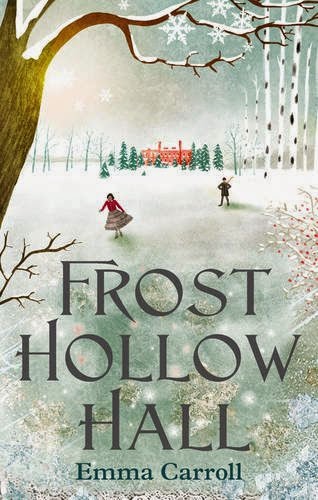
Today I'm very lucky to be interviewing Emma Carroll, author of Frost Hollow Hall and The Girl Who Walked On Air. I'd like to thank you for agreeing to do this interview and for taking the time out to answer some questions for Mr Ripley's Enchanted Books. I must confess that I've not read this latest book. However, after reading the following answers I will be searching out a copy straight away. I really enjoyed Frost Hollow Hall which I read in 2013.
1.Tell us a little bit about The Girl Who Walked On Air?
Abandoned as a baby at Chipchase’s Travelling Circus, Louie dreams of walking the tightrope. One night in the big top a terrible accident occurs. The circus is desperate to find a new showstopper and so Louie gets the chance to perform. Yet with the arrival of a mysterious top-hatted man, her dream come true quickly turns into a nightmare.
2.Give us an insight into your main character. What does she do that is so special?
Louie has a great talent for walking the tightrope. She is ambitious, brave, a bit of a show off. Yet she trusts the tightrope far more than her emotions. Her biggest fear is confronting her past.
3.What did you think of the book cover for The Girl Who Walked On Air. Who did it?
I adore it! Faber have done the most beautiful covers for my books. They use gorgeous fonts and I love the foiled blue of the lettering. The dog on the cover was modeled on my own dog Bagel, which makes it very special. The designer is Julian De Narvaez- his work is fantastic.
4. What are you working on at the minute?
I’ve just started the first draft of my fifth book for Faber. It’s set in the summer of 1816 at the Villa Diodati, and tells the story of Shelley’s inspiration for ‘Frankenstein’ from the viewpoint of a young housemaid.
5.What was the hardest part of writing your books?
First drafts, definitely. Mine are awful: the writing I’m most proud of tends to come when the story has ‘fermented’ a bit.
6.What inspires you to write?
People, books, photographs. A particular smell or sound. A view from a window. Passengers on trains. Pretty much anything and everything, really.
7.Which actor/actress would you like to see playing the lead character from your book?
I’m rubbish at fantasy casting! Um… maybe Ramona Marquez ( the little girl in Outnumbered who doesn’t look like the little girl in Outnumbered anymore)?
8. Do you have a special time to write or how is your day structured?
My writing days tend to start with tea and books. Then I go for a quick dog walk to wake up properly and aim to start writing by 10am-ish. I probably work best before lunch, but sometimes it takes a while to get going, so the better stuff comes later in the day.
9. Do you think book bloggers have a role to play in the publishing industry?
Absolutely! I think it’s especially true on children’s publishing when so little time and space is given via more traditional media platforms. Bloggers are passionate about books and passionate about authors. They are incredibly supportive, intuitive, informative. Since being published, I’ve met some amazing bloggers who’ve given me such brilliant support, and taught me an awful lot about kids’ books. I’m absolutely indebted to them.
10.Is there anything else you would like to tell us?
Every year I eat one Cabury’s Crème Egg- just because. I’m gutted to hear they’ve changed the recipe so might have to break with tradition this year.
Brandon Sanderson - The Rithmatist - Published by Orion Children's (23 May 2013)
Joel is fascinated by the magical art of Rithmatics, but unfortunately only a chosen few have the necessary gift and Joel is not one of them. Undaunted, Joel persuades Professor Fitch to teach him Rithmatic theory - and soon finds that his knowledge is put to the test when someone starts murdering the top Rithmatic students at his school.
But can Joel work out the identity of the killer and stop them before they realize just what a threat Joel actually is?
Alexia Casale - The Bone Dragon - Published by Faber and Faber (2 May 2013)
Evie's shattered ribs have been a secret for the last four years. Now she has found the strength to tell her adoptive parents, and the physical traces of her past are fixed - the only remaining signs a scar on her side and a fragment of bone taken home from the hospital, which her uncle Ben helps her to carve into a dragon as a sign of her strength. Soon this ivory talisman begins to come to life at night, offering wisdom and encouragement in roaming dreams of smoke and moonlight that come to feel ever more real.
As Evie grows stronger there remains one problem her new parents can't fix for her: a revenge that must be taken. And it seems that the Dragon is the one to take it. This subtly unsettling novel is told from the viewpoint of a fourteen-year-old girl damaged by a past she can't talk about, in a hypnotic narrative that, while giving increasing insight, also becomes increasingly unreliable.
A blend of psychological thriller and fairytale,The Bone Dragon explores the fragile boundaries between real life and fantasy, and the darkest corners of the human mind.
Michelle Lovric - The Fate in the Box - Published Orion Children's (2 May 2013)
Fogfinger rules Venice. His Fog Squad and spies are everywhere. The Venetians fear him and obey him. Every year one of their children is lost in a grisly Lambing ceremony. The child must climb the bell tower and let the Fate in the Box decide their destiny. Most end their days in the jaws of the primeval Crocodile that lurks in the lagoon. Or so Fogfinger tells them. But a chance meeting by a green apricot tree between Amneris and Tockle may be the beginning of the end for Fogfinger.
Silk and sewing, a magical glass kaleidoscope, mermaids and misunderstood Sea-Saurs, talking statues and winged cats, blue glass sea-horses, a spoiled rich girl and a secret society are just some of the ingredients in Michelle Lovric's exquisitely imagined and superbly plotted fourth fantasy set in Venice.
Allen Zadoff - Boy Nobody - Published by Orchard (23 May 2013) Boy Nobody is the perennial new kid in school, the one few notice and nobody thinks much about. He shows up in a new high school, in a new town, under a new name, makes few friends and doesn't stay long. Just long enough for someone in his new friend's family to die -- of "natural causes." Mission accomplished, Boy Nobody disappears, and moves on to the next target. When his own parents died of not-so-natural causes at the age of eleven, Boy Nobody found himself under the control of The Program, a shadowy government organization that uses brainwashed kids as counter-espionage operatives. But somewhere, deep inside Boy Nobody, is somebody: the boy he once was, the boy who wants normal things (like a real home, his parents back), a boy who wants out. And he just might want those things badly enough to sabotage The Program's next mission.