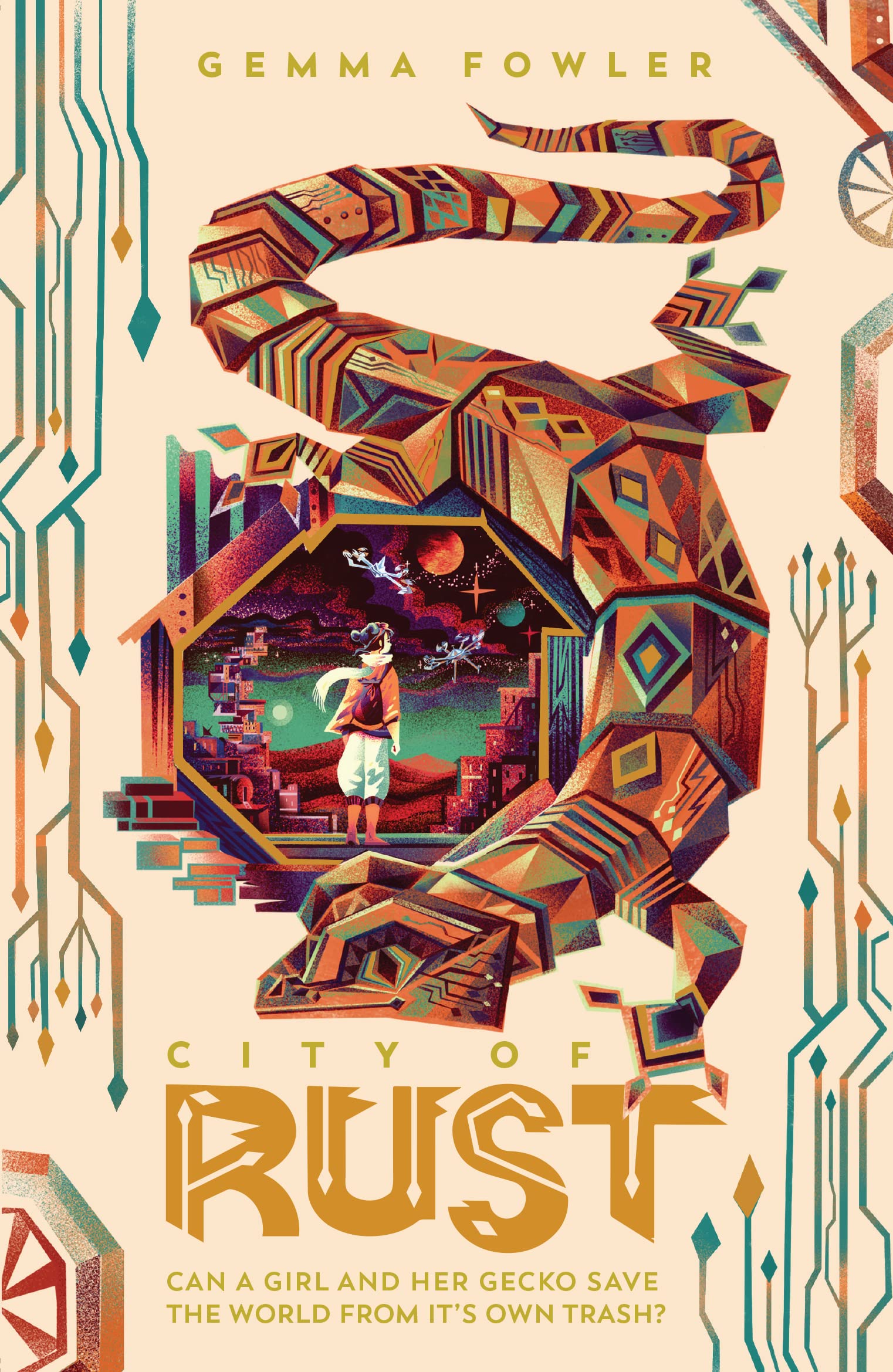
Here we have a winning combination; a great book cover, and a fantastic story. This was one of the most original stories of 2021 (published by Chicken House books) and we loved it. It was really great to be able to ask some questions about the book as well as find out more about the author behind it. If you are ready for Astronaut wee and Cornish pasties predicting the future then you must read this enjoyable interview with Gemma Fowler. In the meantime, enjoy and we'll see you back for the next interview very soon. You can buy HERE.
City of Rust is a very intriguing title. How would you best describe the book to potential new readers?
City of Rust is a nail-biting sci-fi mystery adventure, set in a city built entirely out of junk called Boxville. There’s drone racing, bio robotic animals, Sphereships, mechanical bounty hunters, and terrifying junker clans ruling the skies. Phew!
What would you like readers to understand from this book; is there an important message behind the story you would like readers to pick up on?
Apart from having a load of fun reading it, I’d love readers to understand that the book is inspired by the rubbish problem we have on Earth. I really struggle with the fact we have (nearly) driverless cars now, but still struggle to recycle our waste. It’s nuts!
I love the book cover for City of Rust. What do you think and how does it illustrate the story inside?
Oh I love the cover! It’s by Karl James Mountford, who’s a bit of a legend anyway, but I think he really knocked it out of the park with this one!
A lot of people think the book has a steampunk vibe after looking at the cover (I think it’s the rusty colours). It does have a few steampunky traits, but it’s really not that kind of world at all. Blade Runner meets Wall E meets Star Wars!
Are there any movies you think might have influenced the book and would we pick up on any of these references through the story?
STAR WARS. STAR WARS. STAR WARS.
When did you get the first idea for this book and has the journey taken you to any unexpected places?
I read an article about the space debris problem (there are 180 million pieces of space waste in orbit around the Earth right now and counting), did a big groan about the state of humanity, and then an image of a space junkyard popped into my head that was too cool to ignore!
Have you had any personal conversations with the characters in the book?
I wouldn’t say I have conversations with them, they sort of talk at me and I write it down. It doesn’t feel like it comes from me at all. Which sounds crazy but it’s just the way it works!
Now the book is written it’s like having a group of friends that you miss hanging out with, I find myself thinking ‘Atti would love this’ or ‘If Railey were here she’d have fixed that already’, things like that.
Can you tell us about any writing projects you are working on at the moment?
City of Rust has been selected for the Summer Reading Challenge this year, which has a Gadgeteers theme, so I’m working on updating my website with some bits and bobs to go with that over the summer.
I’m currently working on a new book that features a Cornish pasty that can predict the future. That’s all I will say for now! Ha.
What question were you hoping to be asked and why?
Ok. I’m a weird fact machine (I bore people with my facts on a daily basis), so here are some Gross but True facts I learned whilst researching City of Rust-
There are hundreds of weebergs, made of frozen astronaut wee flying above our heads in orbit right now. Gross!
Gecko’s will drop, and then eat, their own tails if there isn’t enough food around (don’t worry, Atti doesn’t do this in the book). Ew!
The reason the residents of Boxville live on sugary snacks and drinks (Floss and Pop), is that sugar, in its purest form, doesn’t grow bacteria, and can still be eaten years and sometimes decades, after its best before date. Blugh.
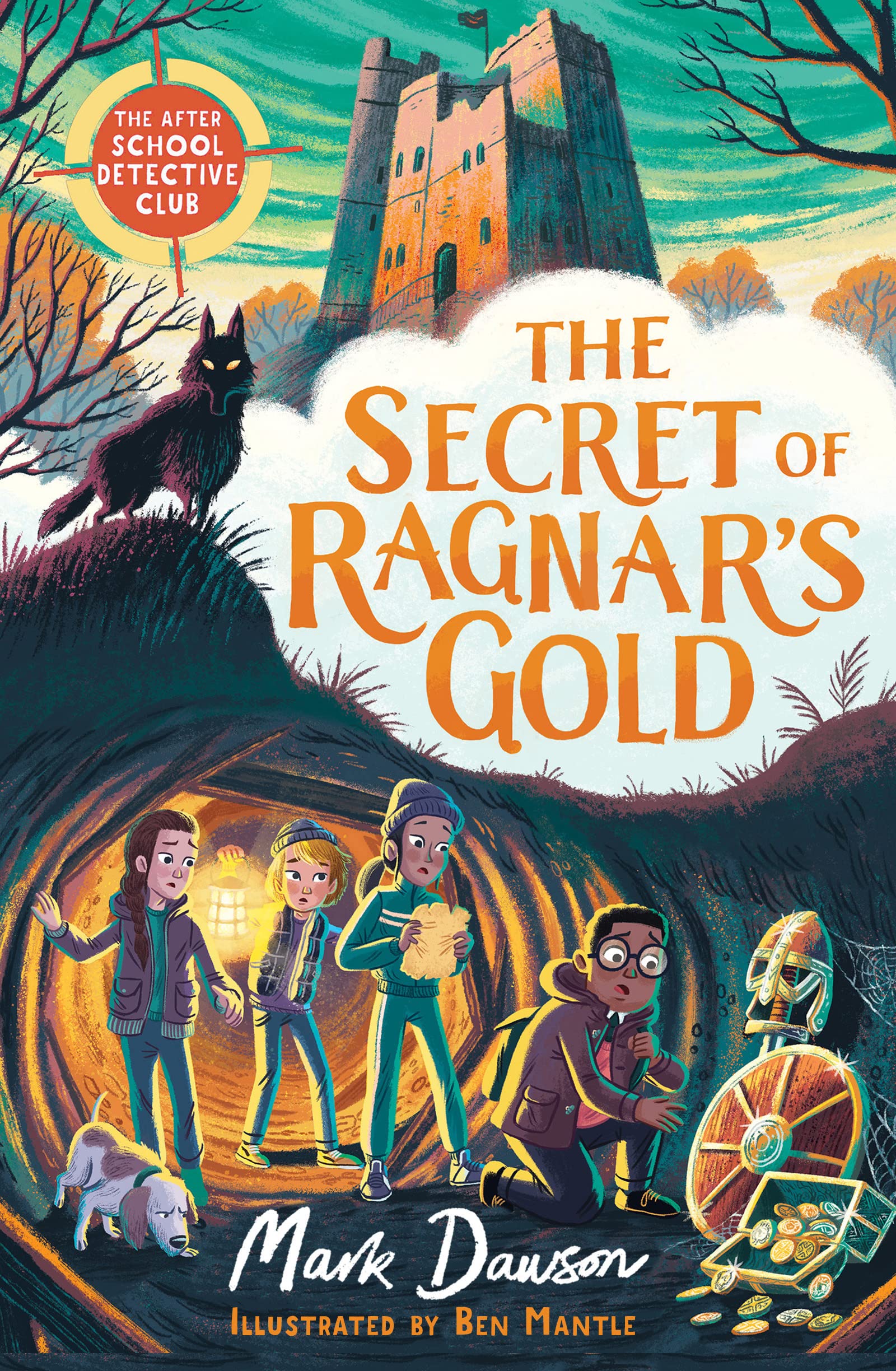
Today we have another cracking interview with our good friend Allan Boroughs. One of his recent projects is co-writing a new detective series with fellow author Mark Dawson. The first two books have been published this year with Welbeck Flame whilst another book is due to be published in Jan 2023 entitled The Mystery in the Marshes. All the books are illustrated by the talented illustrator Ben Mantle. So, it's time to be transported back to your eight-year-old self where you'll have the power of seeing the world in a fresh and unique way whilst playing the drums. Have a great day and weekend! You can buy it HERE.
You have just written a new series of books with Mark Dawson, how did that come about and what can we expect in the series?
I knew of Mark from his adult thrillers and his work in the independent publishing space. A friend of mine called me one day and said he’d seen a post from Mark saying he was looking for a children’s writer to collaborate on a new series. I got in touch and we got talking, I followed him home a few times, leapt out of dark alleyways, super-glued myself to his car etc and eventually he agreed to work with me. It was a natural fit really.
The After-School Detective Club involves a group of friends (Max, Charlie, Joe and Lucy and their faithful dog, Sherlock) as they solve crimes and mysteries in and around their home town of Southwold.
Mark and I both agreed early on that we wanted the series to evoke the stories we loved as kids such as the Famous Five and Just William stories. However, the world has moved on quite a bit since Enid Blyton’s days so we also wanted stories that were based in the modern world where the gang have to deal with modern criminals as well as tackling real-world problems like difficult parents, bullies and schoolwork.
Mostly, the stories are about the value of true friendship and how everyone has something to offer, however much of an outsider they feel.
What makes the After-School Detective Club so special for the characters and how did they all get involved?
We thought a lot about the characters at the outset and deliberately made them as different as possible in terms of personality, interests and backgrounds. They are all thrown together by chance, one evening in Southwold and, at first, they don’t get on particularly well. However they become firm friends when they are placed in a dangerous situation and have to rely on each other to save themselves.
Creating very different personalities gave us a lot of opportunity for humour, disagreements and for each member of the gang to bring unique skills to each adventure. Like all the best gangs, they also have their own hideout – no spoilers but they think it’s ‘the best place in the world’.
What is the process like when you co-write a series and do you both agree on everything that happens in the plot and book?
As with all the best collaborations there is some tension in the process – some things we agreed on straight away, others we went backwards and forwards on until we found something we both liked. We spent the most time thinking about the location, the characters and how they would work together before we really thought about the story. Once we’d got the chemistry right between the main characters, the stories really took care of themselves.
Having someone else to work with on a story is great. When you think about it, most modern films and TV shows are written by teams of people. By comparison, the idea of a lone author, sitting at home and writing entirely by themselves is a little strange.
The second book entitled The Secret of Ragnar's Gold will be published at the end of June (2022); will this book work well as a standalone read or do you think there is a need to read it in a sequence for it to be fully understood and enjoyed?
The stories are all standalone adventures so you can read them in any order you like. At the same time, there are some characters that turn up in different stories and the relationships between the gang develop over time so I think readers will get more out of them if they read them in order.
Ben Mantle has illustrated both book covers in the series, do you think a good cover can help readers to select and identify a book they would like to read purely on its aesthetics?
Ben is my hero. He not only did the covers but all the interior illustrations as well and his artwork really brought the books to life. The first time I saw his sketches I laughed myself silly – he captured the characters perfectly and drew them with such humour that it was like seeing the story for the first time.
A good cover is an essential part of the package in any book and this is particularly true for children’s books. A great cover can really help a young reader to start to visualise the story before they have read the first page. When it is so critically important to encourage children to read at an early page – a great illustrator and a classic cover are indispensable.
What project are you working on at the moment?
The After-School Detective Club is progressing rapidly and I am currently working on Book 5 in the series. No spoilers but my story research included a trip to Ireland as well as googling the question “can you put a dog through an airport scanner”.
Apart from that I am also finding a bit of spare time to finish Book 3 in my own kids’ sci-fi detective series, Starless and Black, and I’m learning how to play the drums. The books are going well – the drums, not so much.
Which books do you read for pleasure?
I love reading and devour as many books as my spare time will allow although my reading choices can be a little eclectic. Favourite reads include the Laidlaw detective series by William Mackilvanney; classic sci-fi/speculative fiction by William Gibson, Ursula Le Guin and Margaret Atwood, spy novels by Le Carre and anything and everything by Neil Gaiman.
My current read is ‘Winnie-the-Pooh’ (honestly) which I am re-reading for probably about the twentieth time. It is funny, sad, endearing and a perfect example of how a well-crafted children’s book can tell us fundamental truths about the way the world works.
What question would your younger self ask your older self and what would be your answer to this?
Eight-year-old me would probably want to know how much I earn – which as any children’s writer will tell you is one of the questions they get asked most often on school visits.
Much-older me would probably say something like – don’t even think about how much money you’re going to make from writing – if you want to make money, start a business or go and work in a bank or something. But if you want to be a writer, then do it because if there is just the tiniest chance that someone will read something you’ve written and it makes them laugh or cry or think about the world in a different way then, that is worth more than any amount of money.
Oh, and by the way, eight-year-old me – don’t ever stop thinking like an eight-year-old because it’s the one time when you have the most amazing original thoughts about the world that are entirely yours. As you get older, other people’s ideas will crowd in on your own until you’ve forgotten which ideas are yours and which are just something you read somewhere.
I think eight-year-old people are the ones most likely to see the world in a fresh and original way – we should put them in charge.
The greatest illusion of all is the art of telling a good story; the trick is there is no trick. It's time to dream and let your imagination take hold in this brilliant fantasy adventure with the author, Justyn Edwards.The Great Fox Illusion was published by Walker Books (April 2022). Check this book out as I believe it just might be the READ you are looking for this summer. We hope you enjoy it and see you again soon!
The Great Fox Illusion is your debut book and was published in April 2022. What illusion do you put the readers under and do you think they will enjoy the fantasy experience?
Stories have a very similar flow, rhythm and structure to a good magic performance. A trick often starts with an everyday object and then surprises you with a vanish or a transformation. Finally, it ends with a crescendo or by returning everything to normal. A good story follows a very similar pattern. Thinking about that made me want to write a story about tricks that was itself a kind of trick. I really hope that others will enjoy the fun in that process.
What do the characters make possible in the plot that would have otherwise been impossible?
I loved writing about Flick and Charlie. When they first meet,Flick isn’t too keen on Charlie – they’re both very different. But the way they combine and learn to work together in this book is something I really enjoyed bringing to life. The personalities those characters have, how contrasting they are, how flawed they are, and yet how they help each other makes the book possible.
How did you go about plotting this book and did you have any idea it would become a series?
Right from the start, I planned this book as the first in a series, and I had the rough shape of what follows from the off. The plot of this book is only an opening skirmish.
What do you think you learned when writing this book and will it help you with your next book?
I've learnt a lot. Working with my agent to send this book off to publishers and now working with my editor has been an invaluable experience. They’ve been brilliant at probing the story, getting me to check and cover the details and think through all the angles. Hopefully, I've put these lessons into practice while writing the second book in the series (just finishing this off now), and then it’s time to have another go with the third book, which I need to start writing any day now.
You state you are not very good at nuclear physics or DIY (the same applies to me). What would you suggest that you are good at?
Hmmmmm. Maybe not much! I think my one skill in life is to keep trying. Hopefully, the second book will be better than the first…
Does your degree in archaeology help in any way with the next book in the series? Can you share any glimpses of information about it?
Ha! There’s no archaeology in the second book.What can I tell you about it without giving too much away? The Great Fox Illusion ends with Flick and Charlie thrown into the world of magicians and illusionists, and they’ve made some enemies along the way. Let’s just say, in the second book that the sheer magnitude of what they’re up against becomes apparent – they’ve got the attention of some scary and ruthless people. They have stepped through a door into a new and dangerous world where they discover the true power of the Bell System.
Can you share a magical moment that you have had in real life that might inspire us to write or read more books?
I think our imagination is such an important thing. I can’t think of any particular moment that crystalises that, but the process of creative writing and exercising our minds when reading is vital for us all.It makes us more rounded, more empathetic, and more outward-looking people.
What one question do you wish you had been asked as part of this Q&A and why? How would one of your characters have responded to this question?
An important question about this book is who designed the stunning cover. Charlie would give you a very long answer to this (as all of his answers tend to go on a bit), but I’ll keep it short. Flavia Sorrentino. She did it, and it looks amazing. I’ve also seen some roughs for her cover for the next book and… Well, you’ll have to wait!
We are celebrating the publication of Dance Magic (Autumn Moonbeam) which is the debut book of Emma Finlayson-Palmer. It is due to be published on the 7th July 2022 by UCLan Publishing (Preston University). The book is illustrated by Heidi Cannon and is part of a series of stories following the main character Autumn Moonbean. Younger readers can follow her adventures and life experiences. In this interview, we find out more about the book and the author. It is a chance to celebrate together the publication with a sparkle, a dance, and a flourish of magic. We hope you enjoy it and thanks for visiting.
Your first book is for 5-8-year-old readers, Autumn Moonbeam: Dance Magic and is due to be published in July 2022 (UCLan); what magical fantasy world have you created for the story?
Autumn lives in an area called Sparkledale in a country called Cauldronia, where creatures live and do similar things to me or you but with a magical twist. There are spell-a-visions and talking doorbells that will shout at you to answer the door, and a main character who dreams of one day joining a dance club, and going to the Aaarghlympics.
Autumn Moonbeam is the main character of the book; how do you think younger readers will be able to identify with the character?
Whilst it's not mentioned as such in the book, Autumn is autistic, and I hope some of her neurodivergent traits will feel familiar to younger readers. And certainly the anxious fluttering moths in her tummy, shyness, and sometimes being a little clumsy will be relatable to many readers. She's a worrier, but she's also kind and loyal and is determined to follow her dreams.
As an adult writer, what process(es) do you undertake to write for this age group, and do you think you have got all of the aspects you wanted to include in the book right?
I'm a mom to five children, worked as a childminder for over 13 years, been a helper in playgroups, and I'm also working as a lunchtime supervisor in a primary and have done for over seven years, so I've had a lot of experience around children who are the same age as Autumn and her friends. In truth, I never left that more playful stage myself, it was around the age of 8 or 9 that I knew I wanted to be a writer. I hope I've got all the aspects in that I wanted, and feel like I've created authentic characters (albeit witches and fairies and other magical beings), that children will be able to identify with or get excited by.
The book is illustrated by Heidi Cannon; what can you tell us about the illustrations and how do they contribute to the storyline?
Heidi has done such an amazing job at bringing Autumn's world to life. Despite being an artist myself, I couldn't have imagined all the intricate details that Heidi has created. The illustrations are so much fun, and often there are small details to spot in the background. Heidi's images bring the words alive.
What hurdles did you have to overcome to get your book published? Do you have any good tips for writers who are looking to get published?
I have been writing for many years, and started off writing letters and short stories to magazines in the hope of getting into print. Once I discovered I especially loved children's fiction I tried writing for all different ages groups over the years and have discovered that I have a special love for the magic of chapter books. I would highly recommended reading as much as you can when you are a writer. It's one of the key things to being a good writer, I think. Read new releases, see what sort of stories are popular, and what trends there are, don't follow a trend, just learn from it. Most importantly, write something that excites you, because if that book gets an agent or publisher's interest you're going to be working on edits and talking about the same story a lot, and also your passion will shine through in your writing.
You have a big passion for reading children's books; which book has recently caught your attention?
I read a lot so it's hard to pin down just the one but I've recently read Three Girls by Katie Clapham, such a heart warming tale of friendship and a passion for running. I've also recently read the second Rainbow Grey book, Laura Ellen Anderson's books are an absolute joy to read and to see her stunning illustrations.
What are your favourite blogs or websites for writers?
Write Mentor has been a wonderful and supportive community to be part of and I can highly recommend getting involved. The same with Write MAGIC too, such wonderful supportive writers with fun groups to take part in sprints and other writing activities.
Is there a dream you have yet to follow and could it make it into any future books?
Ooh this is both a hard but really interesting question. One dream I've always had is to see the aurora borealis, that could definitely feature in a future story. I've also got my more unrealistic dream of being able to turn into a bird and fly, so that will definitely have to be lives through my writing!
Today it's a pleasure to welcome Scottish author Lindsay Littleson to Mr Ripley's Enchanted Books. This interview is very much overdue so it's time to catch up with the author's recent book THE REWILDERS; a thrilling adventure story. The book was a finalist in our recent book cover wars which was very exciting. We hope you enjoy our interview by finding out more about Lindsay's books and her writing career. You can support the author by reading one of her fantastic fantasy adventures. You can buy HERE.
The Rewilders is your latest book to be published by Cranachan Books (March 2022). How would you summarise the story in a new synopsis to grab the readers' attention?
The Rewilders takes readers on an exciting adventure to the stunning Highlands. Esme and Callum are on a quest to rewild a young lynx, but their journey is fraught with danger; including a raging river, angry farmers and a pack of menacing wolves.
Esme is one of the main characters in the book, how do you make your characters believable and stand out from the plot?
For me, creating believable characters is the most important part of writing a novel, because even if the plot’s adventure-packed, if readers don’t care what happens to the characters it’s impossible to create suspense and tension. Readers need to know what makes a character tick, and why they behave as they do, but that understanding should develop and deepen as the story progresses and we find out more about them.
From bad-tempered Mary Lennox in The Secret Garden to bossy, dramatic Bertha in The Titanic Detective Agency, flawed characters are always more interesting. Lewis in Guardians of the Wild Unicorns can be grumpy and intolerant, but he is courageous, and he is a loyal friend. Perfection’s dull, and isn’t remotely believable!
Although Esme in The Rewilders might not be immediately likeable, there are reasons behind her behaviour, and hopefully readers will understand, or even relate to, different aspects: her feelings of anxiety when her mother leaves, her fear of stepping out of her comfort zone, perhaps even the fact that she is best friends with a bully because she’s afraid of the consequences of stepping away from the friendship.
At school, Esme has been siding with her friend Isobel, even when she knows very well that Isobel’s behaviour is frequently unkind. During the journey across the moors to rewild the lynx, Esme has the time and space to consider the effect bullying has on others and she realises she has to make changes and find the courage to become the person she wants to be.
Did the Highland landscape inspire any part of the story?
The Highland moors and Scotland’s ancient temperate rainforests are both the setting of and the inspiration behind The Rewilders. The Highlands are glorious, but the terrible truth is that over the years, the landscape has been damaged and degraded and is now in desperate need of repair and regeneration. The message in the Rewilders is primarily about the urgent need to protect and repair our precious wild environments, as much for our own sake as nature’s.
Only fragments of internationally important Scotland’s temperate rainforests remain, and discovering about them inspired this description in The Rewilders.
With its craggy rocks and gushing waterfalls, this place felt other-worldly—like a fantasy film set—a magical forest of wood elves and unicorns. But it wasn’t magical, it was real; a living reminder of Scotland’s past. Weak autumn sunlight slanted through the mainly deciduous trees, a mixture of birch, ash, hazel and a few ancient, gnarled oaks. Their bark was crusted with rust-orange lichen, their leaves turning scarlet and gold. Spongy moss carpeted the soggy ground and furred the tree branches.
Do you think being a Scottish author that local heritage is important to portray in children's stories?
Obviously, Scottish authors should feel free to write the stories they are passionate about, and I don’t feel restricted to writing stories set in Scotland, as The Titanic Detective Agency proves! But I do believe it’s important that children are aware of their local history. I spent many years as a teacher in the Paisley area, and the main reason for writing my Victorian novel, A Pattern of Secrets was to give local children information about their town’s incredible textile heritage, within an adventure story about 12-year-old Jim who escapes from the Abbey Poorhouse and has to attempt to save his little brother from the same fate, by retrieving a lost family heirloom.
While The Rewilders is set in Scotland and focuses on the topical issue of rewilding large predators, such as lynx and wolves, to the Highlands, the novel’s main message is a global one. It’s vital that we all do our part in protecting and restoring our planet’s natural environments and in caring for our precious, vulnerable wildlife.
What kind of books did you enjoy reading as a child?
The Borrowers series was a revelation. The novels have a gloomy, melancholy air, very different from the upbeat adventure stories of Enid Blyton, all of which I’d already devoured, and I loved Arrietty’s courage and desire for adventure. The Hobbit, Mrs Frisby and the Rats of NIMH and the Narnia books were all fantasy favourites too. But I also enjoyed character-driven stories about children to whom I could relate in some way, like Kate Ruggles in The Family From One End Street, surrounded by siblings and desperate for a place to read in peace.
You have a number of successful books that have been published, at what point do you decide to commit to writing a story to the very end or choose to abandon it?
When I first began writing I produced quite a few stories that should have been abandoned at an earlier stage and which eventually ended up in a drawer. Gradually, I realised the way I worked needed to change. More planning at the initial stages was essential, to try and reduce wasted time. So now, when an idea first emerges, I doodle my characters and annotate the drawings; describing each character’s physical appearance and personality traits, both negative and positive. Then I might draw a map of the setting or create a family tree. If I’m feeling really keen to tell this story and in love with my characters, then I’ll begin writing rough chapter outlines and hopefully from those, I’ll be able to produce a workable first draft. But obviously there are no guarantees!
What feelings do you have when you walk into a place filled with books?
Libraries always make me feel nostalgic. I remember so clearly visiting our local library with my mum every week. She would have a little wheeled trolley with her, because she’d borrow so many heavy hardbacks, one from each section of the library, that we couldn’t carry them home. I’d skip into the children’s section, fingers crossed that there would be something new, something I hadn’t yet read.
When I enter a second-hand bookshop, I breathe in the slightly musty smell, and feel a thrill of anticipation and a buzz of excitement, because I’m on a treasure hunt. My latest treasure is a battered copy of Selfridge’s Household Encyclopaedia from 1929, which earnestly explains that appendicitis is caused by swallowing fruit pips or toothbrush bristles and has some excellent advice on the etiquette around visiting cards.
What question would you have loved for me to have asked you and why?
I would have loved you to ask me what I am working on at the moment, because my brain is currently buzzing with ideas for A Spy’s Guide to Europe, the teaching resource I’m creating to accompany my new MS, Euro Spies. The novel is about three school children on a whirlwind trip around Europe, who are catapulted into a world of art, espionage and terrible danger. Euro Spies features fiendish clues, all hidden on famous European landmarks, and lots of hard-to-crack codes. The novel was an absolute joy to write and it’s coming out in April 2023.
We all love a Danny Weston book, especially me! Therefore, it was great to catch up with the man himself as part of our next author interview. His latest book, A Hunter's Moon, has been published by UCLan Publishing. It is another masterclass in storytelling that will leave your spine tingling and your fantasy imagination in overdrive! You can check out our book review HERE to find out more. We hope you enjoy this interview and can be tempted into walking the "darkside" of fiction. It's time to enter at your peril; good luck and we hope to see you again.
You are a man of mystery so please tell us about your latest mystery and why we should read it?
My latest book is called A Hunter’s Moon. It’s a folk-horror tale inspired by the Scottish legend of the Cù Sìth - the supernatural wolflike creature said to haunt the forest of Tay, the servant of the mysterious Walkers in the Woods. Since moving to Scotland several years ago, I have been taking a lot of inspiration from Scottish folklore and this legend is one that I hadn’t previously heard about, but I instantly felt compelled to write about it. People should read this book if they like a dark mystery with a supernatural twist. It was conceived and written during the lockdown and, it was only after I finished, I realised it could be seen as an allegory about COVID 19.
You have a fantastic way of writing really scary but believable stories. Do some elements in your books have a certain amount of truth to them? If so, could you share what these are?
Firstly, thank you for the compliment. I would say that all my books have truths in them, but they are cunningly disguised as fiction. What I mean is that no matter how fantastic the premise of a story, the characters and the world in which they live must be rendered in an entirely believable way. Once a reader is convinced about the people in the story, they’ll start to care about them. And then they’ll be willing to suspend their disbelief when the story ventures into the realms of the fantastic.
What scares Danny Weston in fiction and in life?
It’s great fun to be scared by fiction. I’ve loved reading horror stories since my teens and the beauty of this kind of horror is that it's caged within the book. I love a good short story. Roald Dahl used to specialise in them before he started writing for younger readers. And I love the short stories of Ray Bradbury and H.H. Munro (Saki). A reader knows that what’s happening on the page cannot really hurt them.
Real life is a lot scarier - and what scares me are the big subjects like global warming, the rise of the far right, poverty, famine and the possibility of war - all totally out of my control. The best thing about being a writer is that I can have autonomy over the worlds I create. I can impose a kind of order on it all.
I hear you and Philip Caveney are good pals; who do you think would win in a written dual and why?
The two of us used to say terrible things about each other, but lately we’ve been on surprisingly good terms. I think we’ve both come to accept that we owe each other a great deal and I’m finally ready to admit that without him, I wouldn’t be where I am today. Also, I’m not sure how you’d do a written duel. Fountain pens at dawn?
Which book are you most proud of writing and is there anything you’d change about it looking back?
Inevitably, the book I’m most proud of is my very first, The Sins of Rachel Ellis. It was published way back in 1977. I know I’ve written better books, but this was the one that started the ball rolling. I had been trying since my teens to get a book published and there were two serious attempts before this one. (Looking back, I can see that I wasn’t ready.) Rachel Ellis was my last gasp, do-or-die attempt to crack the nut and thankfully, I got there. I was twenty-six years old and it felt like I’d just climbed Mount Everest.
What kind of childhood did Danny Weston have? What kind of books did he enjoy reading that influenced his stories when he got older?
I had a peripatetic childhood, which is a posh way of saying I moved around a lot. My dad was in the Royal Air Force so every two years, we upped sticks and went to another air base (most of them in Lincolnshire). So I had one of those old-fashioned childhoods where you wander about the countryside, damming streams, climbing trees and generally getting up to mischief. Then my parents got posted to Singapore and I ended up in a horrible boarding school in Peterborough. It’s interesting to note how many of my books feature a boy who has been separated from his parents. Just saying.
I hear your drawing skills are very good; could you draw one of your favourite characters from your book?
I trained as a graphic designer a very long time ago, but I’m rusty these days and usually prefer to leave that kind of stuff to the professionals. I did however come across a sketch I did a few years back, when I was in the early stages of writing Mr Sparks and decided to try and capture the look of the central character. He’s a two hundred year old ventriloquist dummy and may just be the single most evil character I’ve ever created. The finished cover (by James Fraser) is a thousand times better.
Is there a particular question that you would not have liked me to ask? If so, what is it and why?
I hate it when I’m visiting a school and a pupil asks me that question. ‘Please sir, how much do you earn?’ I hate it for two reasons. One, because money and writing are two entirely different things and two, because it’s always embarrassing when you start crying in public. You can buy the book HERE.
It's time to explore another interview with you today; an epic interview with funny man author David Solomons. His new book, A Beginner's Guide to Ruling the Galaxy, is just about to be launched into orbit on the 7th July 2022 with Nosy Crow Books. It's all about handing in your homework on time or maybe NOT?
I have really enjoyed reading the responses to the questions posed. I particularly agree with the last part of question seven and would like to know your thoughts after reading this interview. You can share on Twitter with us @Enchantedbooks and with David Solomons @DavidSolomons2 if you have anything to say on this topic. Look forward to hearing from you and enjoy the post.
A Beginner's Guide to Ruling the Galaxy is your new book, please could you sum up this book in the craziest way possible?
Space opera in the suburbs. It’s that old story of boy meets girl next door. Girl turns out to be heir to the galactic throne who’s on the run and hiding out on earth from… ah. No spoilers.
After writing five fantastic books in My Brother is a Superhero series, what challenges did you have starting with this new book? Did fresh ideas flow from the very first page?
Thank-you for the compliment! I find that ideas flow in much the same way that blood does from an open wound. There’s a lot of them, but it’s a painful process. On the first question, enough time had passed since I’d closed the final chapter on the My Brother series that I didn’t feel those books hovering at my shoulder and peering at what I was doing now. Although, as I write this, I realise that everything I’ve ever written is shelved three feet behind me and could be said to be looming over me judgementally.
Are laughter and humour always going to be David Solomons's key writing ingredients? Do you feel it is important that readers engage through laughter when reading your books?
I don’t set out to write funny books, it’s just the way they come out. I’m an inveterate noodler when it comes to funny scenes – I find myself going over and over them like some mad scientist – word choice, sentence rhythm, electrodes – in an effort to draw out the maximum lols. I can’t envisage writing a book that doesn’t contain humour; to do so would require a level of self-restraint that I have thus far failed to demonstrate in my life. Though I would say that, in my own mind anyway, I pay as much attention to the other elements. I challenge myself to make the stories funny andexciting, funny and poignant. It’s a tricky balance. For example, putting a snarky line into a character’s mouth at the wrong time can undercut what could and should be a dramatic moment. After years working together my editor, Kirsty Stansfield at Nosy Crow, is very good at reigning in my overenthusiastic tendencies!
Most of the characters you write about have a superpower, what is your superpower?
I can bend time so that deadlines just bounce off me.
Everybody loves an evil villain, which villain would you love to have a real-life conversation with and how do you think it would go?
First one that comes to mind is Darth Vader, but it would be Eddie Izzard’s version of him from the legendary Death Star canteen routine. In which case our conversation would probably end with him killing me. With a tray.
Which of your books would you like to see being turned into a film and why?
Any of them! And as for the reason, are you hoping for something more meaningful than fame, glory and a thumping great first day principal photography fee? I’ve been endeavouring to get my books into development/production for years, with a modicum of success. Steve Coogan’s company optioned My Brother is a Superhero, and I wrote a script for a proposed TV series, but that went away. I continue, Charlie Brown-like, to put my work in front of producers. In my other career as a screenwriter, I’ve written the screenplays for three films, including a version of Five Children and It, which I’m pleased to say continues to enjoy a life long after its debut.
These days I write screenplays mostly with my wife, Natasha. And they’re mostly adaptations of her books (for grown-ups). So, the other answer to your question is I’d like to have a film made purely to justify all the hard work we’ve put into the process.
How important do you think it is to get children to read for enjoyment?
I have a nine-year-old and a six-year-old. For them there isn’t any other kind of reading. By which I mean they’ll only read if the experience is enjoyable. Our eldest is going through an interesting reading phase. I’m in the fortunate position that I’m aware of what’s brand new in the world of children’s fiction. It used to be I could put anything in front of him and he’d read it, but from hoovering up every kind of book, reading three or four a week, he’s slowing down. Still reading and enjoying, but I get the sense that he’s starting to form his own likes and dislikes. He’s happy to reject dad’s suggestions! The six-year-old is just finding her reading feet, but she already has strong opinions, especially when it comes to line readings. At bedtime, when Natasha or I are reading to her, she’ll make us stop if she thinks we’ve flubbed a line. Then she’ll read it the way it ought to be performed.
To go back to the original question, it makes my heart ache. Our whole industry ultimately relies on enough of these little people wanting to pick up a book. It’s why I get so angry when some publishers foist substandard fiction on them. Kid reads average book with huge marketing budget and shrugs: I’ll go back to YouTube thanks. Yes, publisher gets immediate sale, but what about the long-term? Is that kid going to turn into a lifelong reader if her early exposure to books is so flawed? I know it’s not as simple as that, but it doesn’t help.
8. What question were you hoping to be asked in this Q&A and why?
Is the author who appears in ‘My Cousin is a Time Traveller’ based on you?
So, in the last of the Superhero series our heroes get an author visit at school, a dismal presentation from a sweating, under-rehearsed children’s writer. I was quite emotional, writing the last of this series, and I knew I was saying goodbye to characters who’d had transformative effect on my life. So I wrote myself into the story in order to say goodbye to them ‘in person’. However, since I pantsed much of that novel (i.e. made it up as I went along) my character turned out to have a bigger role than I’d intended. Thanks for asking. You can buy HERE.
Hello Everybody! This week we have another wonderful interview; I'm delighted to introduce Maisie Chan, who is the author of Danny Chung Does Not Do Maths. Her latest book is Keep Dancing Lizzie Chu and was only published this month (June 2022) by Piccadilly Press. In this interview, we are given a fantastic insight into the author, her relationship with her stories, and the characters of the books. I have really enjoyed reading the author's responses to the questions and hope these inspire you to pick up a copy of the book, which can be purchased HERE.
Your recent novel is called Keep Dancing, Lizzie Chu and will be published on 9th June 2022 with Piccadilly Press. How did you pitch this book idea to the publisher?
When I sold Danny Chung Does Not Do Maths I had to pitch a second book. I wrote down a one page pitch about a Chinese goddess who comes to earth but she's had enough with being a goddess and wants to be human. That book isn't Keep Dancing, Lizzie Chu! However, I did want to keep the aspect of having a Chinese goddess in a more contemporary story. I had also written a teen novel about a girl who looks after her grandfather who has dementia, so I tried to put the two ideas together. I then wanted to infuse it with popular culture as I felt that TV and films had been a blessing over the lockdowns.
Have you based any of the characters in the story on real people?
Well, I have some experience of being a young adult carer who looks after an older man, so I guess Lizzie has some links to me. Chi and Tyler her best friends aren't based on people I know. I did name some characters in the book using the names of my friends but the characters aren't them. Wai Gong (grandfather) is loosely based on my dad Ron, who had dementia and used to see someone he called 'Angel' so that sort of made it into the plot!
There is a mention of sausage sandwiches in the plot; what would be Lizzie Chu's favourite sandwich fillings?
Lizzie loves roast dinners, so I reckon she would like roast chicken (with the skin on) on some white crusty bread with butter, maybe with a smear of mayo.
Lizzie comes up with an idea in the book to take Wai Gong on the trip of a lifetime to Blackpool. Why Blackpool and did you visit it as a child?
I used to go to British seaside towns a lot as a child. We didn't have money to go to fancy places like....Benidorm! We would go to Blackpool on the coach and see the illuminations. We also went to Rhyl and Barry Island a lot. I remember there was a swarm of flying ants one summer. It was my worst nightmare!
(Maybe that could be a good topic in a future book?)
Your first book was called Danny Chung Does Not Do Maths. What did you learn from writing this book that helped you to develop Keep Dancing, Lizzie Chu?
I had much less time to write Keep Dancing, Lizzie Chu than I did Danny Chung. My editor was there from the beginning, which wasn't the case during the early drafts of Danny Chung. I think having an expert there in the early stages really helps so there are fewer drafts needed as they can steer you in the right direction a bit earlier. What I did differently with Lizzie Chu was to have a much stronger opening chapter where there is more action and tension.
You are a British Chinese author who lives in Glasgow, are there any particular aspects of your cultural heritage that may we find in the characters and the plot?
There are fewer British Chinese cultural elements in Keep Dancing, Lizzie Chu and this was because unlike Danny Chung, I wasn't trying to introduce British Chinese culture to those who didn't know much about it. I wanted the story to be about a girl who really wants to do a nice thing for her grandad, and they're fairly British in the sense that they speak English to each other and aren't always eating 'Chinese' food (which to Chinese people is just called 'food'!). There are aspects of Chinese stories in the book. I used to dress up as Guan Yin when I was a storyteller, she's the goddess of compassion and mercy. So there are stories about her that are Chinese. She's one of the most beloved Chinese deities. Later on, I put in the Journey to the West story which is one of the most famous Chinese novels of all time. So the journey of Lizzie and the gang, mirrors the journey in that famous story which has the Monkey King in it.
I love a good dance, what music would you and Lizzie Chu dance to?
I think Lizzie would dance to Cha-Cha-Slide which has elements of the cha cha cha but also is funky! I really like all kinds of music, old-school hip hop, RNB, Soul, Pop, World Music and Classical music.I like dancing, but I'm definitely not great at it! I can't do routines! But I can freestyle!
How important is it to write books for children and do you think there is a place for adults to read and enjoy them as well?
Writing books for children is very special. I think there are multiple levels of things going on when you write for children. The most important is the story. Then books can promote empathy. Some children can see themselves for the first time when reading my book. That's important to me as I didn't have a book like Danny Chung or Lizzie Chu when I was growing up. There was nothing at all, and they still remain very few books like mine out there which is a shame. I've had many adults tell me that they enjoyed Danny Chung and I think Keep Dancing, Lizzie Chu will appeal to adults too, especially if they like Strictly Come Dancing!